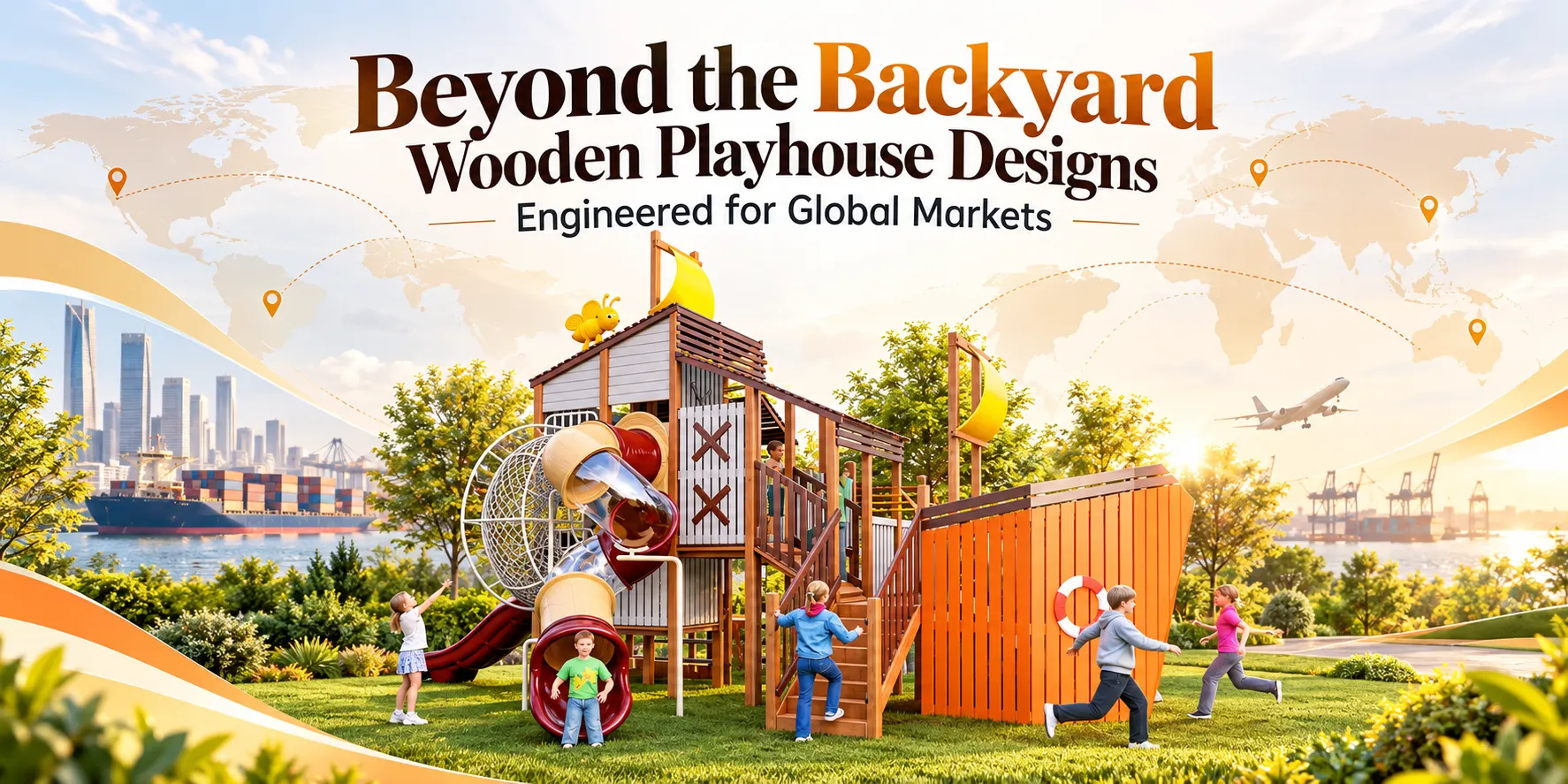
Sourcing wooden playhouses in bulk for multiple markets means balancing safety rules, shipping costs, and regional style preferences. One wrong specification can delay a whole container or trigger costly returns. A wooden playhouse is a child-sized outdoor structure made from timber, available as pre-built units, flat-pack kits, or modular systems for residential and commercial use. This guide maps product types, materials, compliance, and cost drivers for B2B buyers sourcing for multiple countries.
Wooden Playhouse Product Types and Configurations for Global Sourcing
Catalogues from an international playground supplier usually list three build formats: pre-built, flat-pack DIY, and modular.
- Pre-built units ship assembled. Wholewoodplayhouses’ Bluebird 8×8 arrives ready to site, which suits dealers who have local installation crews.
- DIY kits such as Summerwood’s models pack flat, cutting freight volume and appealing to retail chains and e-commerce sellers.
- Modular systems let buyers mix wall panels and roofs, so one SKU family covers several price points.
Feature sets and style variants:
- Doors, windows, lofts, slides, sandboxes, and verandas.
- Rustic, farmhouse, cottage, and modern looks; Wayfair groups these under a single category.
Match specification to the market rather than sending one range everywhere. North American buyers favour lofted 8×8 cabins; UK and European distributors lean toward compact cottage designs with sandpits for smaller gardens. Coastal or humid regions justify cedar, while dry inland markets accept treated pine. Material choice then decides how each format performs outdoors.
Comparing Wood Materials and Design Styles for Importers and Distributors
Specify the wood before the design. Cedar and treated pine dominate outdoor play structures, and that choice decides your landed cost, replacement rates and returns exposure. Playground equipment distributor sourcing briefs often skip this step, then absorb the cost through claims. The table maps the four timbers most quoted in wooden playhouse RFQs; compare it against your own climate data.
| Wood type | Durability | Cost | Appearance | Ideal markets |
|---|---|---|---|---|
| Cedar | 15–20 years untreated; resists rot and insects | Highest of the four | Warm red-brown, weathers to silver-grey | Buyers avoiding chemical preservatives; premium garden retail |
| Pressure-treated pine | 10–15 years, re-sealed every 1–2 years | 20–30% below cedar | Pale green when new, paints easily | High-volume and budget garden ranges |
| Fir | 8–12 years when sealed and raised off damp ground | Mid-range | Light, straight grain, stains evenly | Kit programmes and hybrid indoor-outdoor designs |
| Acacia | 10–15 years; dense and hard-wearing | Mid to high, origin-dependent | Golden-brown with strong grain contrast | Decorative play furniture and tropical markets |
Design styles follow similar logic. Rustic log profiles sell through garden centres and farm shops; modern grey-painted cubes suit urban retail and design-led e-commerce; farmhouse styles with gable roofs and shutters hold value in suburban North American markets. Stain colour shifts between batches, so request finish samples before committing a container. Each style can ship as a flat-pack kit, which is where private-label and OEM programmes begin.
Private-Label and OEM Opportunities in DIY Wooden Playhouse Kits
Flat-pack kits are the simplest format to private-label. Panels, fixings and hardware ship in one carton, so your own name can go on the box, the assembly guide and an interior label — without altering the timber profile.
Customisation usually starts with footprint (6×6, 8×8, 8×10), then shifts to roof colour, trim shade, and loft or sandbox additions. Suppliers commonly permit a small number of accessory swaps per order, enough to build a distinct SKU per market.
Cross-border work needs more than a logo. Manuals must be written in the destination language, and carton text often has to satisfy local labelling rules. Because flat packs nest, a container carries several times more units than assembled houses, cutting freight per unit. That gap drives most private label playground equipment and OEM playground export programmes, and it feeds directly into your landed cost calculation.
Cost Factors and Manufacturing Considerations for Wooden Playhouse Production
Your cost-to-make figure matters less than your landed cost. Quote from the factory gate outward, and ask suppliers to break a wooden playhouse price into its parts. Five variables move the number most:
- Raw timber: cedar typically costs about double treated pine, and knot grade or board thickness shifts the figure again.
- Labour: lofted playhouses with ladders, platforms and glazed windows take more machining and assembly hours than single-storey cottages.
- Hardware and finishes: hinges, screws, stains and water-based treatments per unit.
- Packaging and volume: playground shipping and packing costs fall per unit when parts nest flat in cartons.
- Trade terms: FOB excludes freight and CIF bundles it in, so compare both quotes under playground Incoterms.
Tooling and setup spread across the run, which is why volume often beats material choice on unit price. Each decision above carries into age grading and market testing.
Age Suitability and Safety Compliance for Wooden Playhouses in Multiple Markets
Age grading is set before the drawing stage. Toddler models (18 months–3 years) keep platforms under 600 mm with guardrails on every open side. Preschool frames (3–5) add 900 mm decks, ladders and handrails. School-age sets (5–12) allow climbing walls and lofts. Buyers searching “what age is a wooden playhouse for?” need that split stated per SKU, not per catalogue.
| Region | Standard | Typical scope |
|---|---|---|
| US | ASTM F1148 | Home play equipment, ages 2–12 |
| EU | EN 71 and EN 1176 | Toy safety; public play equipment, surfacing, fall heights |
| International | ISO 8124 | Toy safety, closely aligned with EN 71 |
Certification drives material and process choices, so multi country playground projects usually need one tested configuration. ASTM F1148 targets entrapment gaps, rounded edges and non-toxic finishes. EN 71 limits heavy metals in coatings. ISO 8124 overlaps EN 71 closely, letting one test pack serve several markets. Match reports to the current standard version; a 2023 EN 71-3 amendment clears EU customs, not the US. Specify the strictest market’s timber treatment and fixings, then run a single batch.
About JQ Playground – globalplaygroundsource.com
JQ Playground (Wenzhou Jiqi Amusement Equipment Co., Ltd.) is a children’s playground equipment manufacturer founded in 1993. The company provides design, customization, large-scale manufacturing, sales, installation guidance, and after-sales support for outdoor playgrounds, indoor playgrounds, soft play, water playgrounds, PE board playgrounds, kindergarten furniture, outdoor fitness equipment, pet playgrounds, and playground facilities. Approved company facts include 180+ employees, a large Wenzhou production base, 20+ production lines, 55 production machines, ISO/BSCI/EN1176/EN71/ASTM/CPC/CPSIC certification references, 100+ patents, free design support, OEM/ODM capability, trial installation before shipping, export experience, and one-year quality warranty.