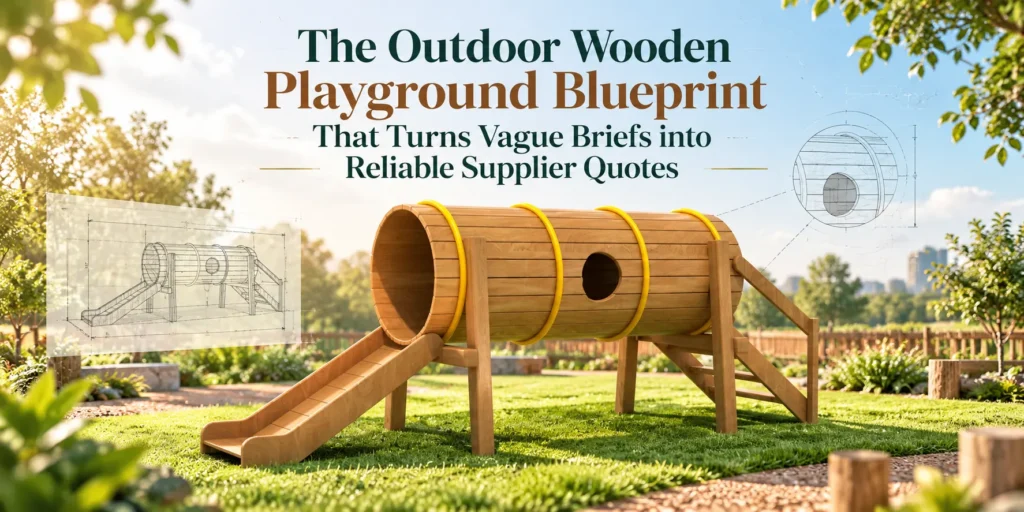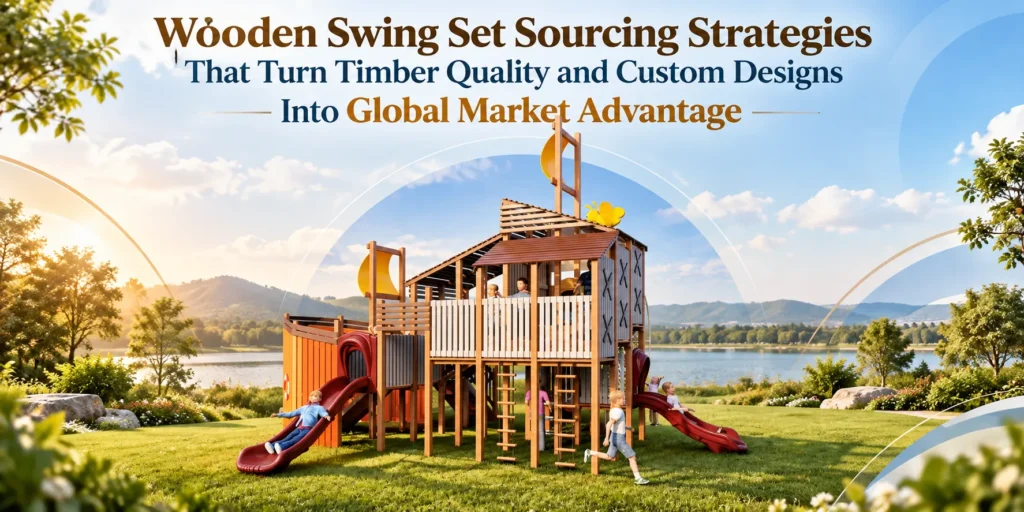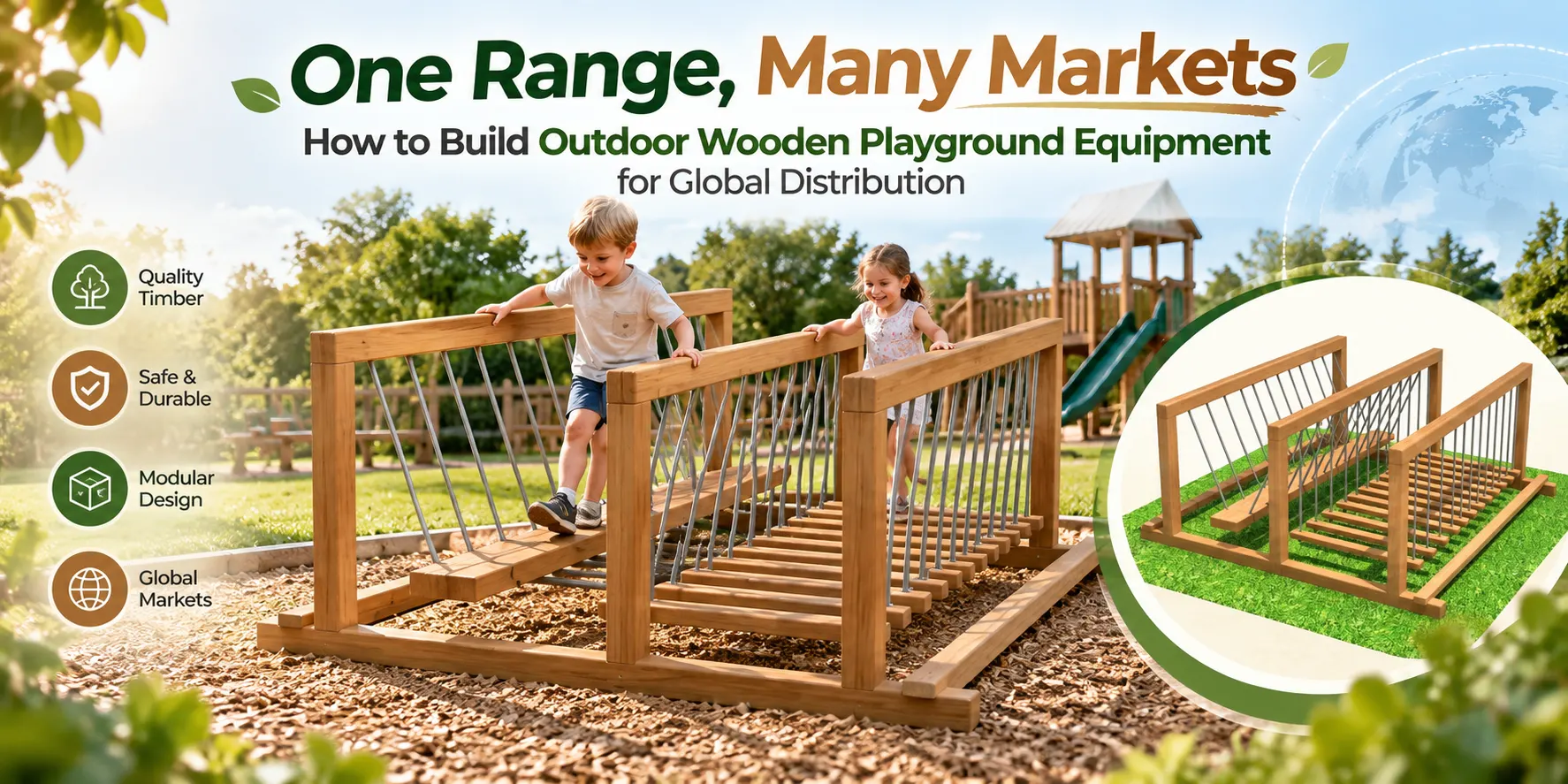
Your sourcing team must build one outdoor wooden playground equipment range that sells across several country markets. Yet the retail search results you study are single-market consumer catalogues, each shaped by local tastes and regulations.
Outdoor wooden playground equipment means modular timber play systems — swing frames, platforms, slides and climbing elements — supplied as knock-down kits for assembly at destination.
This guide covers four decisions: range architecture, timber specification, component standardisation, and colour-to-container planning.
Outdoor Wooden Playground Equipment Categories: Swing Sets, Castle Systems, and Clubhouse Playsets
Retail pages ranking for this term split castle and clubhouse lines into separate collections, so mirror that tiering in your own catalogue — buyers compare like with like, and a clear four-step ladder makes quoting faster. Each tier carries a different footprint and a different buyer.
- Basic A-frame swing sets: two-post timber frame, roughly 2.5–3 m span; built for mass retail.
- Multi-activity backyard playsets: tower, slide and swing arm in one kit, about 3–4 m wide; mass retail and mid-tier distributors.
- Castle-style systems: two or more towers joined by bridges, 4–6 m footprint; aimed at project contractors.
- Clubhouse playsets: enclosed lower level with upper deck, 4–5 m; project contractors and premium retail.
Timber choice then decides what each tier costs to land, which is where the next specification decision begins.
Cedar, Pine, and Treated Timber: How Wood Grade Drives Cost, Durability, and Paperwork
The next decision is the timber schedule, because it sets both the container price and the documents that travel with it. Retail pages promise splinter-free surfaces, no-chemical-treatment options, and natural finishes. Those are shorthand claims. For outdoor wooden playground equipment, cedar earns a premium through natural rot resistance and stability; pine is cheapest, but knot grade, moisture content, and treatment decide durability; treated timber sits between.
Landed cost turns on species availability, knot grade, kiln-dried moisture content, sanding quality, and destination climate. Boards dried poorly can cup in dry markets; humid markets expose under-finished end grain. Timber paperwork travelling with each container should match the invoice. Lock this schedule before the component list.
| Species | Typical use | Finish behaviour | Cost position |
|---|---|---|---|
| Cedar | Premium decks, roofs | Stable; stains well | Highest |
| Pine | Frames, budget kits | Knotty; needs treatment | Lowest |
| Pressure-treated | Structural, ground contact | Moves until dry; finish later | Mid |
Standard Component Sets From Swings and Slides to Platforms and Climbers
Every comparable bill of materials starts with the same question: what actually ships in the carton? Group parts by play function so quotes line up.
- Swinging: belt swing, bucket swing, trapeze bar, glider — record seat counts and chain or rope gauge.
- Sliding: wave, spiral, straight, tunnel — note slide length and section count, since splice points drive freight.
- Climbing: rock wall, rope net, ladder, monkey bars — confirm fixing plates and rung spacing.
- Structure: platform decks, tower frames, canopies and roofs, ground anchors — list deck dimensions per tower.
- Hardware packs: bolts, brackets, swing hangers, caps — ask whether packs are per set or per component.
Consumer pages list several of these as optional add-ons, which obscures the base kit. Normalise part names across suppliers and confirm in writing which items are standard and which are accessories before you issue a purchase order for private label playground equipment.
How Custom Color and Configurator Choices Become Private-Label Programs
Most retail sites selling outdoor wooden playground equipment now run a build-your-own configurator: the buyer picks a timber stain, then a roof colour, then a slide colour, then tower and add-on combinations, and the page assembles a set. That sequence is your specification template. Each layer is a variable you can fix under your own label. A private-label program turns those open choices into a closed list, so a repeat order placed eighteen months later arrives in the same finish, packed the same way, carrying the same part numbers.
Lock these four items in writing before the first production run:
- Colour codes and finish references — stain/paint codes for timber, plus roof, canopy, swing and slide colours, referenced to a physical sample or standard swatch number, not a screen image.
- Part numbering — a code per component and per complete set, mapped to the supplier’s own numbers so cross-reference stays possible.
- Packaging and label artwork — carton dimensions, label layout, barcode placement and any market-specific markings.
- Configuration sheet — one signed document per SKU listing every component, colour and accessory, so component sets stay aligned and packing lists match.
Export Packing, Container Loading, and Shipping Documents for Wooden Play Systems
Knock-down flat packing cuts volume but raises carton count: a three-tower castle set may ship as 12–18 cartons, so agree a per-set carton manifest before booking. Plan by cubic metre, not set count. A 20ft holds roughly 28 CBM; a 40HQ about 68 CBM, and timber kits often hit weight limits before volume.
For mixed orders, load by configuration and label each carton with set code, carton x of y and destination market. Shipping marks must match the packing list exactly across multi country playground projects. Incoterms shift who manages timber paperwork: FOB and CIF leave export declarations with the supplier; DAP moves import clearance to you. The container travels with the playground equipment customs documents — packing list, commercial invoice, bill of lading and any destination-requested timber declarations.
About JQ Playground – globalplaygroundsource.com
JQ Playground (Wenzhou Jiqi Amusement Equipment Co., Ltd.) is a children’s playground equipment manufacturer founded in 1993. The company provides design, customization, large-scale manufacturing, sales, installation guidance, and after-sales support for outdoor playgrounds, indoor playgrounds, soft play, water playgrounds, PE board playgrounds, kindergarten furniture, outdoor fitness equipment, pet playgrounds, and playground facilities. Approved company facts include 180+ employees, a large Wenzhou production base, 20+ production lines, 55 production machines, ISO/BSCI/EN1176/EN71/ASTM/CPC/CPSIC certification references, 100+ patents, free design support, OEM/ODM capability, trial installation before shipping, export experience, and one-year quality warranty.