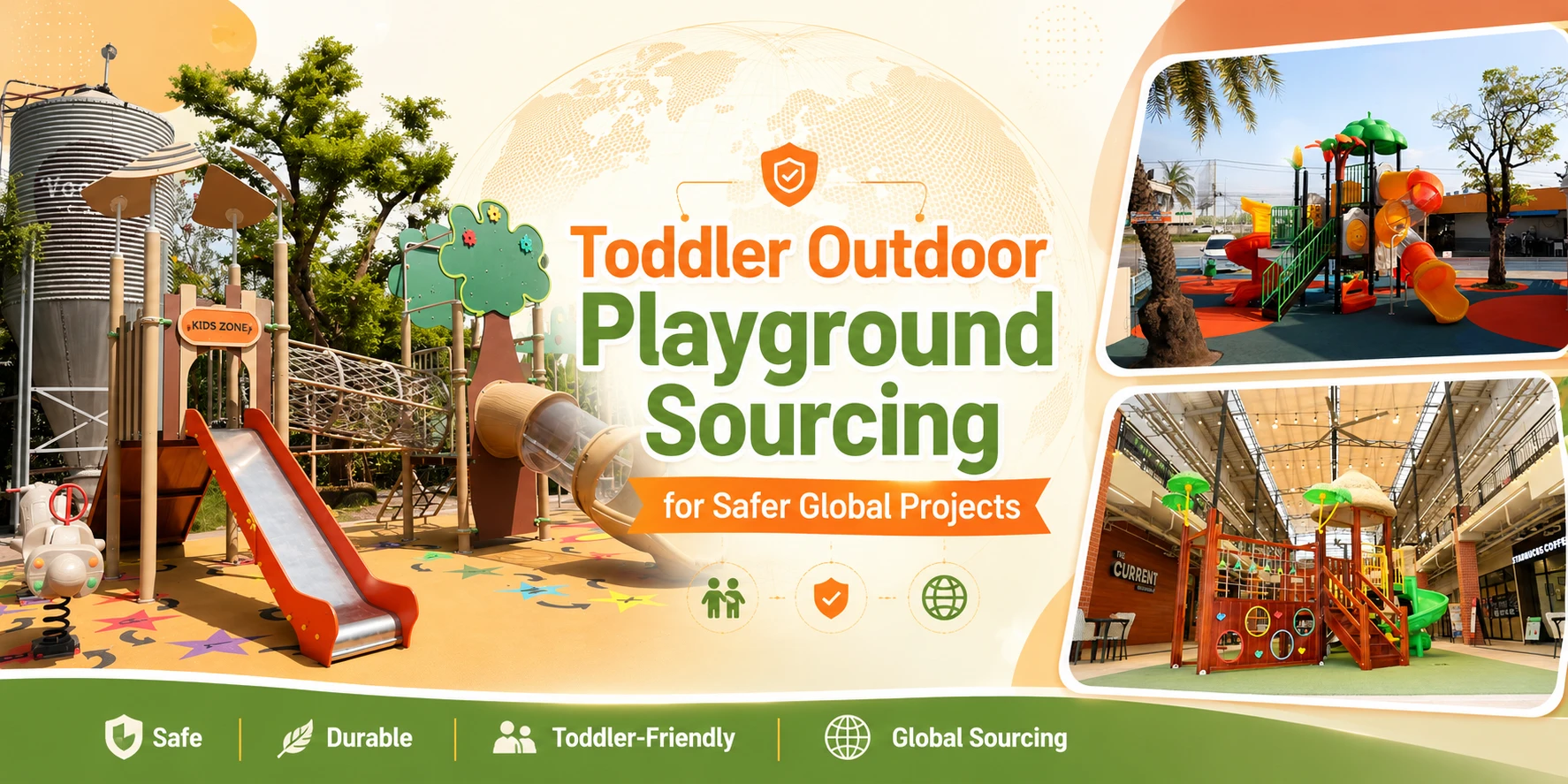
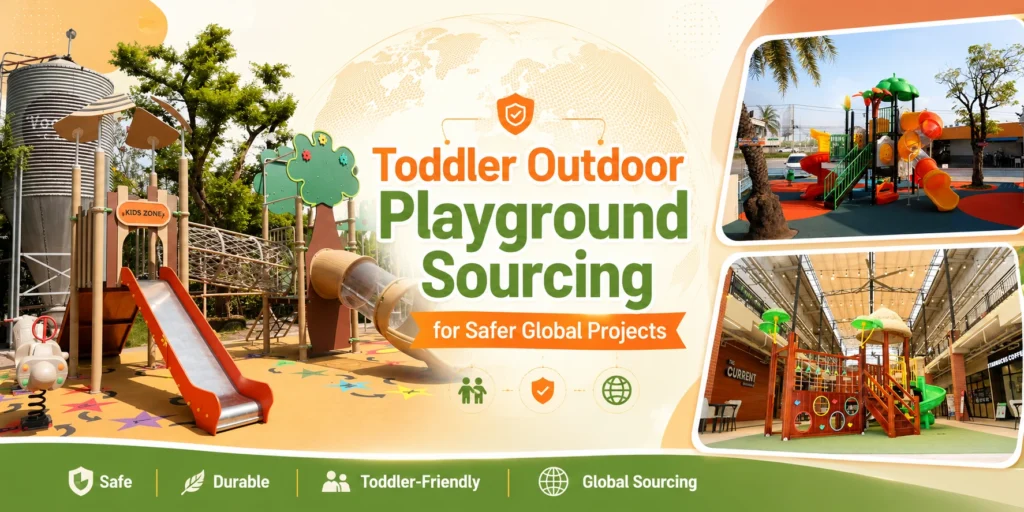
Sourcing toddler outdoor playground equipment for multiple markets adds complexity at every stage. You must reconcile differing safety codes across regions, specify materials that hold up in hot, humid, or cold export climates, and plan logistics that keep installation dates achievable.
These purpose-built structures — referred to as toddler outdoor playground equipment — are designed for children aged 1–5 with low platforms, soft surfaces, and enclosed spaces. Each element responds to known injury patterns: falls from height and limb entrapment are the most common incidents in this age group. That shapes every procurement decision, from supplier evaluation to compliance documentation.
This guide covers the key factors for B2B buyers evaluating products and partners for international projects. Whether you are a distributor expanding your catalogue or a contractor coordinating multiple sites, understanding these considerations helps you source with confidence. For buyers managing cross-border supply chains, a reliable global playground source simplifies compliance and delivery coordination.
Safety Standards and Design Features for Toddler Playgrounds
Two major certification frameworks govern toddler playground safety: ASTM F1487 (North America) and EN1176 (Europe). Both mandate specific design limits for children aged 1–5. Falls and entrapment cause over 70% of playground injuries in this age group, according to CPSC data. You need equipment that minimises both risks from the ground up.
Key design features to verify with any potential playground equipment export supplier:
- Low deck heights – platforms under 1 metre (typically 0.3–0.8 m). Shorter fall distances reduce injury severity.
- Soft fall zones – impact-absorbing surfacing (rubber tiles, engineered wood fibre, or synthetic turf) extending at least 1.8 m around structures. Critical fall height rating must match the deck height.
- Small gap prevention – avoid openings between 89 mm and 230 mm where a child’s head or body could entrap. Also close gaps between 2 cm and 9 cm that trap fingers or toes.
- Rounded edges and smooth finishes – no sharp corners, bolt protrusions, or rough welds at reachable heights. All metal edges should be rolled or capped.
When sourcing from an international playground supplier, request certification documentation and design drawings that show these features. EN1176 also requires annual inspection labels on the equipment itself.
Material Comparison: PE Board, Metal, and Wood for Toddler Equipment
Material choice directly affects toddler safety, maintenance budgets, and product lifespan across different climates. The table below compares the three most common materials used in toddler outdoor playgrounds, with evidence drawn from industry standards and field experience.
| Material | Durability | Safety | Maintenance | Climate Suitability | Cost |
|---|---|---|---|---|---|
| PE Board | UV-stabilised; tested to 2000+ hours QUV without significant fading. Resists cracking down to -40°C. | No splinters, no sharp edges, and no rust. Rounded corners are moulded, not added. | Requires only soap-and-water cleaning. No painting or sealing needed. | Performs in tropical heat, coastal salt air, and cold winters. Top choice for export. | Moderate – tooling investment offset by long lifespan. |
| Metal (Galvanized Steel) | 15–20 year lifespan with proper zinc coating. Resists bending under heavy use. | Can heat up to 60°C+ in direct sun – a burn risk for toddler skin. No splinter hazard. | Check for rust at bolted joints every 6 months. Re-coat if galvanising wears. | Best in temperate or dry climates. Salt spray accelerates corrosion. | Higher upfront; lower maintenance if kept painted. |
| Wood (Pressure-Treated Pine) | 5–8 years before treatment degrades. Susceptible to rot in humid conditions. | Risk of splinters and raised grain. Requires regular sanding and inspection for cracks. | Requires re-oiling or sealing every 2–3 years. More labour-intensive. | Suits mild, dry climates. Swells and splits in high humidity. | Lower initial cost but higher lifetime maintenance. |
For a playground equipment importer guide, PE board offers the most consistent performance across diverse export markets. If you are a playground equipment distributor sourcing for multiple climates, the balance of safety, low maintenance, and UV stability makes PE the default recommendation for toddler equipment. Metal can work in shaded, temperate installations, while wood is increasingly rare for toddler-grade products due to splinter risks and upkeep demands.
Customization Options for Private Label and OEM Buyers
Once the material and safety base are set, customisation turns standard toddler playground equipment into a branded asset. B2B buyers increasingly require bespoke finishes for hotels, retail chains, and franchise playgrounds. These options are typical for private label playground equipment and OEM playground export orders.
Branding: Logos and Custom Colours
Apply your brand colour directly to PE panels or powder-coated metal parts. Logos can be screen-printed or moulded into panels. A hotel chain, for example, might match the play unit colours to its corporate palette for consistent guest touchpoints.
Modular Design Adjustments
Modular frames allow you to adjust platform heights, add or remove slides, and extend walkways. This flexibility supports phased installation across multiple sites without redesigning the entire structure.
Themed Play Panels
Ships, castles, and jungle scenes are common themes. Replace standard panels with themed graphics to differentiate playgrounds for branded kids’ clubs or retail play areas.
Packaging Customisation
Choose between flat-pack knock-down for container optimisation or partially assembled units for faster on-site set-up. Private labelling on outer cartons is available for distributor inventory.
Benefits of customisation
– Stronger brand recall in high-footfall locations
– Faster project approval with tailored designs
– Consistent experience across multiple outlets
– Simplified logistics via optimised packaging
Logistics and Compliance for Cross-Border Sourcing
A standard 40ft HQ container typically holds 12–15 toddler playground sets when knocked down, or 4–6 fully assembled units. The mix depends on model size and packaging density. Knock-down packaging (flat-packed in cartons) reduces shipping volume by up to 60% compared to assembled units, but requires on-site assembly time. Assembled units suit projects where local labour or tools are limited.
Your Incoterm choice affects risk and cost. FOB (Free on Board) places all export responsibilities on you once goods pass the ship’s rail. CIF (Cost, Insurance, Freight) shifts transit risk to the supplier until port arrival – useful for first-time importers. Always confirm which Incoterm is quoted in the RFQ.
Customs documentation must include:
– HS code (usually 9506.91 for playground equipment)
– Certificate of Origin (CO) for tariff preference
– Bill of lading as title document
– Third-party safety test report (e.g., EN1176 or ASTM F1487)
For toddler equipment, additional compliance is non-negotiable. Labels must state minimum age (e.g., “1–5 years”) and maximum user weight in the destination language. Warning symbols must match local regulations – for example, EU markets require pictograms per EN 71-1. Check that packaging carries choking-hazard warnings in French, German, Italian, or other target languages.
Cross-border checklist
– Confirm container loading plan with supplier (product mix per container)
– Choose knock-down or assembled packing based on port handling capacity
– Specify FOB or CIF and document it on the sales contract
– Request safety test reports in English and local language
– Verify age-identification and warning labels meet each country’s standard