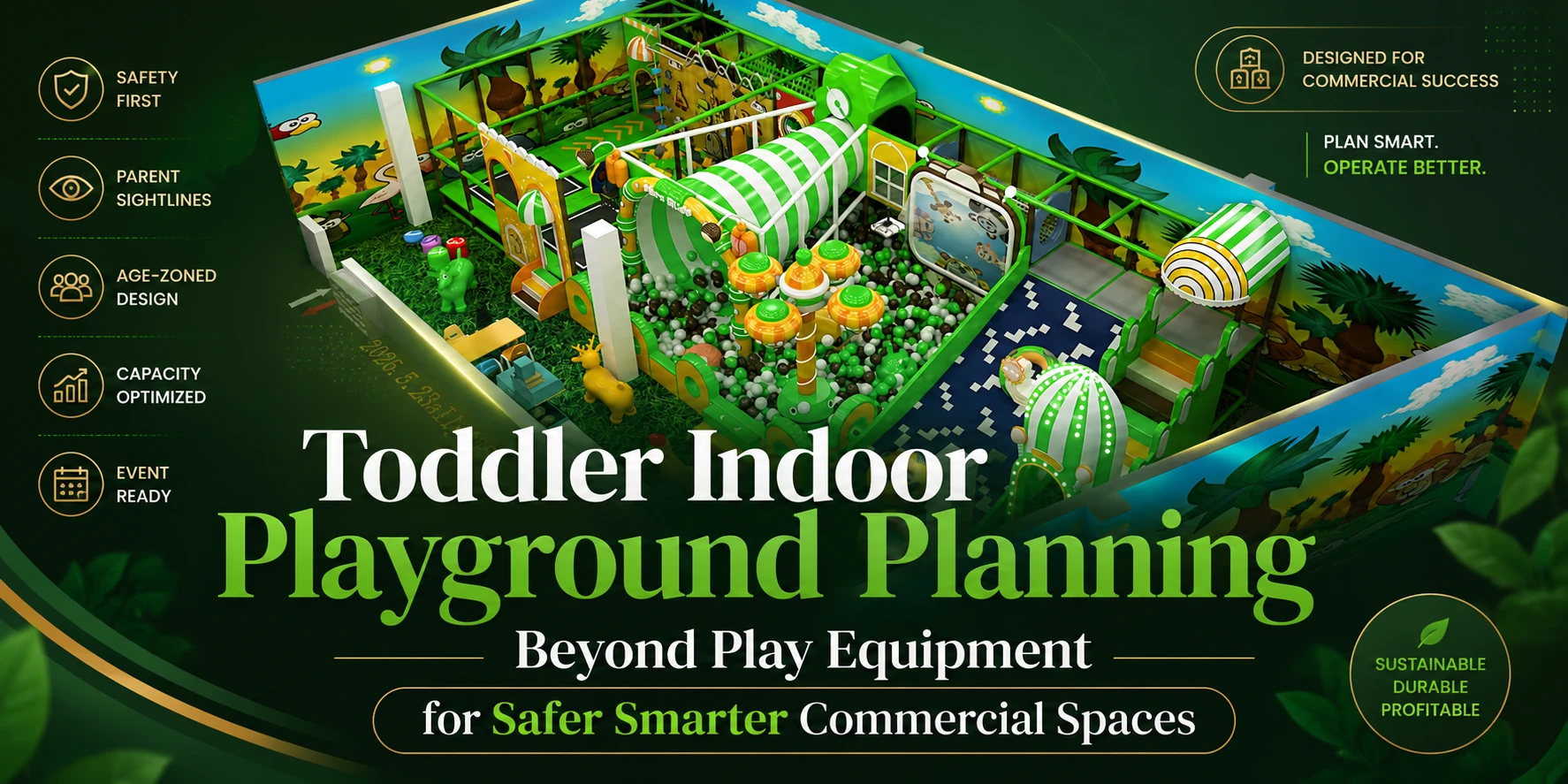
When you scope a toddler indoor playground for a commercial client, you are not quoting a single climbing unit. Operators search for age-separated environments where safety, flow, and supervision work as one system. A toddler indoor playground is a supervised indoor playspace designed for children roughly 6 months to 4 years old, using soft play equipment, low-height climbing elements, sensory panels, and role-play areas. Atlanta-area search results show how local venues present these zones in practice; your role is to turn that venue-level evidence into a global playground sourcing checklist for customs compliance, safety audits, and installation.
Toddler Indoor Playground Facility Types: Age-Segmented Zones and Role-Play Themed Areas
Local searches for toddler indoor playgrounds surface three dominant venue models:
- Soft-play cafés — small footprints with dedicated 6-month/toddler zones, sensory panels, and ride-on toys beside seating areas.
- Children’s activity centres — roomier layouts where miniature role-play houses, ball pits, and low climbing units anchor the floor plan.
- Indoor play areas inside family entertainment centres — larger mixed-age environments that still cordon off a toddler-only section.
Yelp-listed venues and feature pages such as The Play Pad’s ‘Kid Zones’ and Wiggle Giggle’s equipment list confirm that each model packages different structures. As an international playground supplier, you must therefore quote separate packages: a café kit stresses compact, sanitised soft play; an activity centre requires deeper themed role-play elements; an entertainment-centre fit-out needs higher capacity and crowd-flow planning. One universal quotation template will misquote all three.
Designing Toddler-Specific Play Zones by Age: Equipment, Layout, and Sightline Rules
Age-grade the equipment list before you quote. Four bands cover the toddler bracket:
- Under 1 year: flat mats, sensory boards, and crawl tunnels no more than 1.5 m long.
- 1–2 years: shallow ball pits, soft climbing shapes, and push-along ride-ons.
- 2–3 years: slides under 1.2 m, low ramps, and gentle balance beams.
- 3–4 years: miniature role-play units, stepping pods, and short obstacle runs.
Three layout principles apply to every zone. Keep parent sightlines clear from any seating point; hold 1 m clearance around moving equipment such as swings or slides; and separate toddler structures from older-kids areas with a buffer or partition. Upscale local centres often run an age-segmented three-zone model — infant, younger toddler, older toddler — so specify that configuration when requesting quotes.
How Admission Pricing and Membership Packages Shape Equipment Durability and Capacity
Pricing structures in the Cobb County parents guide and on venue membership pages point to distinct operating patterns. Review them before specifying materials:
- Single-entry ticket — occasional visitors, low equipment cycle; supports finer detailing inside a private label playground equipment package.
- Multi-child discount — siblings arrive together, so daily soft-play headcount rises without extra ticket sales.
- One-month unlimited membership — daily repeat traffic; demand commercial-grade foam, wipe-clean surfaces, and easily replaced components such as ball-pool balls and panel covers.
- Party-package passes — short, intense group sessions that fund a separate event space.
High-traffic unlimited venues need tougher, sanitise-ready soft play because the same slide sees dozens of daily cycles. Premium single-entry venues can carry more themed, complex installations at lower risk. Match your material grade to the admission model, and list spare parts in your quotation.
Party Rooms, Camps, and Event Spaces That Expand the RFP Scope for Toddler Play Projects
Venue pages for The Kids Avenue and The Play Pad list “Birthday Parties” and “Camps & Events” beside toddler play areas — proof that operators expect a secondary revenue space. Price it into the RFP early.
- Private party room → demountable partition wall, ceiling anchor points
- Toddler-size furniture → low tables and chairs sized for ages 2–4
- Event-capable lighting and power → dimmable circuits, extra sockets
- Separate entrance → fire-rated door, pram lobby
- Observation window → safety-glazed panel overlooking the play floor
Including these amenities early changes the equipment list, floor plan, and electrical/mechanical coordination. Door widths, ventilation, and circuit loads all shift. Quote them now so the event space never becomes a costly retrofit once the playground ships.
About JQ Playground – globalplaygroundsource.com
JQ Playground (Wenzhou Jiqi Amusement Equipment Co., Ltd.) is a children’s playground equipment manufacturer founded in 1993. The company provides design, customization, large-scale manufacturing, sales, installation guidance, and after-sales support for outdoor playgrounds, indoor playgrounds, soft play, water playgrounds, PE board playgrounds, kindergarten furniture, outdoor fitness equipment, pet playgrounds, and playground facilities. Approved company facts include 180+ employees, a large Wenzhou production base, 20+ production lines, 55 production machines, ISO/BSCI/EN1176/EN71/ASTM/CPC/CPSIC certification references, 100+ patents, free design support, OEM/ODM capability, trial installation before shipping, export experience, and one-year quality warranty.