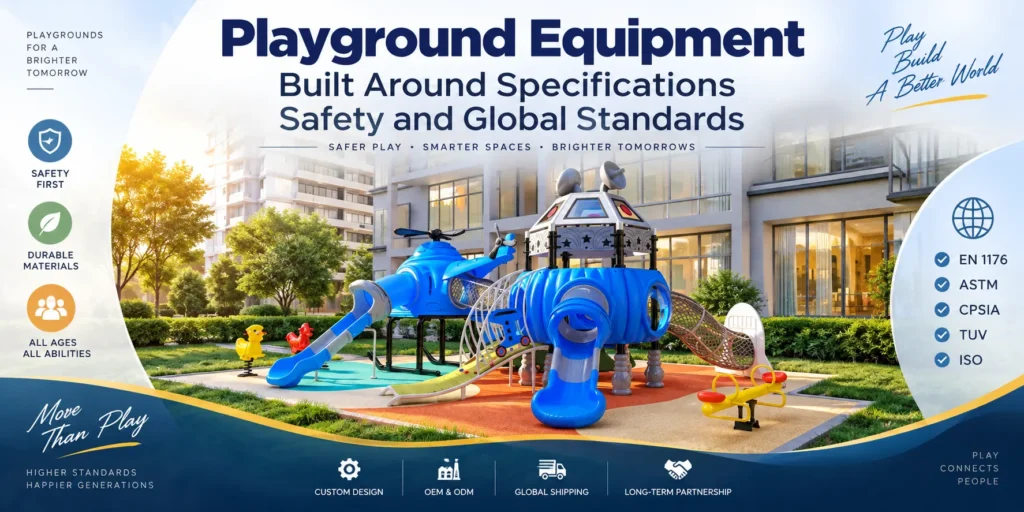
Global playground sourcing rarely fails on price. It fails on specification. A swing seat that satisfies one market’s fall-height rule may breach another’s entrapment limits, and a climbing frame rated for one age band cannot simply be relabelled for another. Multiply that across six export markets and the rework stacks up: new drawings, new samples, new inspections. Sorting products by age group, material and safety standard before you request quotes removes most of that, because suppliers can quote against a fixed brief instead of guessing.
Playground equipment is the collective term for manufactured play structures and their components — swings, slides, climbing frames, seesaws, spring riders, sandpits and multi-play units — installed in schools, parks, nurseries and housing estates. Units are classified by age group, use setting, material (steel, aluminium, timber, HDPE or rope) and load capacity, then specified against regional safety standards that govern fall height, impact-absorbing surfacing, entrapment gaps and structural fixings.
The next section explains how playground equipment works, and the checks buyers run before ordering.
How Playground Equipment Works
Knowing why buyers order leads to how the equipment functions. The operating principle follows four steps:
- Design: calculate static and dynamic loads for the target age group.
- Fabrication: cut, drill, and coat steel, HDPE, and hardware.
- Installation: anchor footings and install impact-absorbing surfacing.
- Repeatability: verify weld quality and hardware grade per batch.
Component roles
Posts carry vertical loads, platforms distribute weight, and moving parts like bearings and swing chains handle wear. As an international playground supplier, confirm each component matches your climate and user age group. Next, compare the specific components and product types that make up a complete set.
Playground Equipment Components and Product Types
A complete playground set breaks into four buying groups. Compare them before you request pricing, because steel gauge and plastic grade drive both cost and lifespan.
| Product type | Typical size range | Main material options | Buyer check |
|---|---|---|---|
| Swing frames | 2–8 seats, 2.2–2.8 m high | Galvanised steel, powder-coated | Post diameter, footing depth |
| Slide units | 1.2–3.5 m deck height | HDPE, stainless, fibreglass | Panel thickness, anti-UV rating |
| Climbing frames | 1.5–4 m wide | Steel core, nylon rope | Rope diameter, joint welding |
| Spring riders | 1–4 seat models | Coil steel, HDPE body | Spring travel, bolt coverage |
Specification details to confirm in writing:
- Fasteners and connectors — stainless or zinc-plated bolts, capped ends.
- Handles and grips — textured, UV-stable, sized for the target age band.
- Surface finish — powder-coat thickness in microns, plus colourfastness.
- Packaging — flat-pack cartons or palletised crates, with part labelling.
Most playground equipment importer guide enquiries stall on missing deck heights and material grades. Fix those two first, then move to application mapping.
Typical Applications for Playground Equipment
Every order maps to a use case first. Age group, site type and daily traffic set deck heights, post gauge and hardware grade.
- Schools and nurseries: age-graded decks (1.2 m for ages 3–5, 1.5–2.0 m for 5–12), 20–50 unit batches, plus load-test reports and age-suitability evidence.
- Municipal parks: modular steel systems, hot-dip galvanised fittings, multi-container schedules.
- Distributors buying private label playground equipment: own RAL colours, logo deck plates, mixed-SKU cartons per region.
- Contractors on OEM playground export work: swing sets, slides and climbing frames combined in one container.
| Application factor | Buyer action |
|---|---|
| Age group | Confirm deck height and fall-height zone first |
| Climate | Specify galvanised or powder-coated fittings |
| Batch size | Ask for carton and container loading plan |
| Quality proof | Request batch inspection records, not sample photos |
Mapping the application settles the specification; the next step is agreeing how a custom or OEM build will run.
Custom Playground Equipment Manufacturing and OEM Cooperation
Once the specification is fixed, a custom build follows a documented path. Supply a dimensioned drawing, a photo set, or a physical sample, plus your colour, logo and packing brief. Settle playground Incoterms and target quantity early, because both shift tooling and unit cost.
| Stage | Your input | Manufacturer output |
|---|---|---|
| Feasibility | Drawing or sample, colour reference, quantity | Material and finish options, indicative price |
| Quote | Confirmed spec, Incoterms, pack style | Itemised quotation, tooling position, lead time |
| Sample | Written approval of pre-production unit | Sample plus dimension and finish record |
| Production | Signed sample, packaging artwork | Batch build with a per-batch inspection log |
| Shipment | Booking instruction, document list | Cartons, pallets, loading photos, shipping papers |
Playground shipping and packing detail — carton strength, pallet height, container fill — belongs in the quote, not the final week. Batch inspection causes most disputes, so agree check points, sampling ratio and sign-off before the run starts. Supplier fit decides who can hold that cadence at volume.
Top 10 Playground Equipment Manufacturers and Supplier Fit
Supplier fit is the final filter, not the first. Four types cover most playground equipment RFQs, and each suits a different buying team.
| Supplier type | Pros | Cons | Best fit |
|---|---|---|---|
| Asian volume manufacturers | Wide range; low unit cost above 500 units | Sea freight; 3–4 week samples | Importers and private-label distributors |
| EU/US OEM brands | EN 1176 and ASTM documentation; fast spares | Higher unit price; rigid branding | Multi country playground projects |
| Regional steel fabricators | Short lead times; bespoke swing frames | Narrow range; little surface testing | Contractors on tight sites |
| Sourcing agents | Mixed-catalogue orders; container consolidation | No factory control; slower fixes | First-time buyers testing demand |
Score shortlisted names on three points:
- Match quoted lead time to your installation window, not your deposit date.
- Request the playground equipment customs documents list up front — HS code, test reports, packing list.
- Ask for a sample in the final colour, then compare written after-sales response times.
Score suppliers on the specification you will reorder, not the sample they send first.
About JQ Playground – globalplaygroundsource.com
JQ Playground (Wenzhou Jiqi Amusement Equipment Co., Ltd.) is a children’s playground equipment manufacturer founded in 1993. The company provides design, customization, large-scale manufacturing, sales, installation guidance, and after-sales support for outdoor playgrounds, indoor playgrounds, soft play, water playgrounds, PE board playgrounds, kindergarten furniture, outdoor fitness equipment, pet playgrounds, and playground facilities. Approved company facts include 180+ employees, a large Wenzhou production base, 20+ production lines, 55 production machines, ISO/BSCI/EN1176/EN71/ASTM/CPC/CPSIC certification references, 100+ patents, free design support, OEM/ODM capability, trial installation before shipping, export experience, and one-year quality warranty.