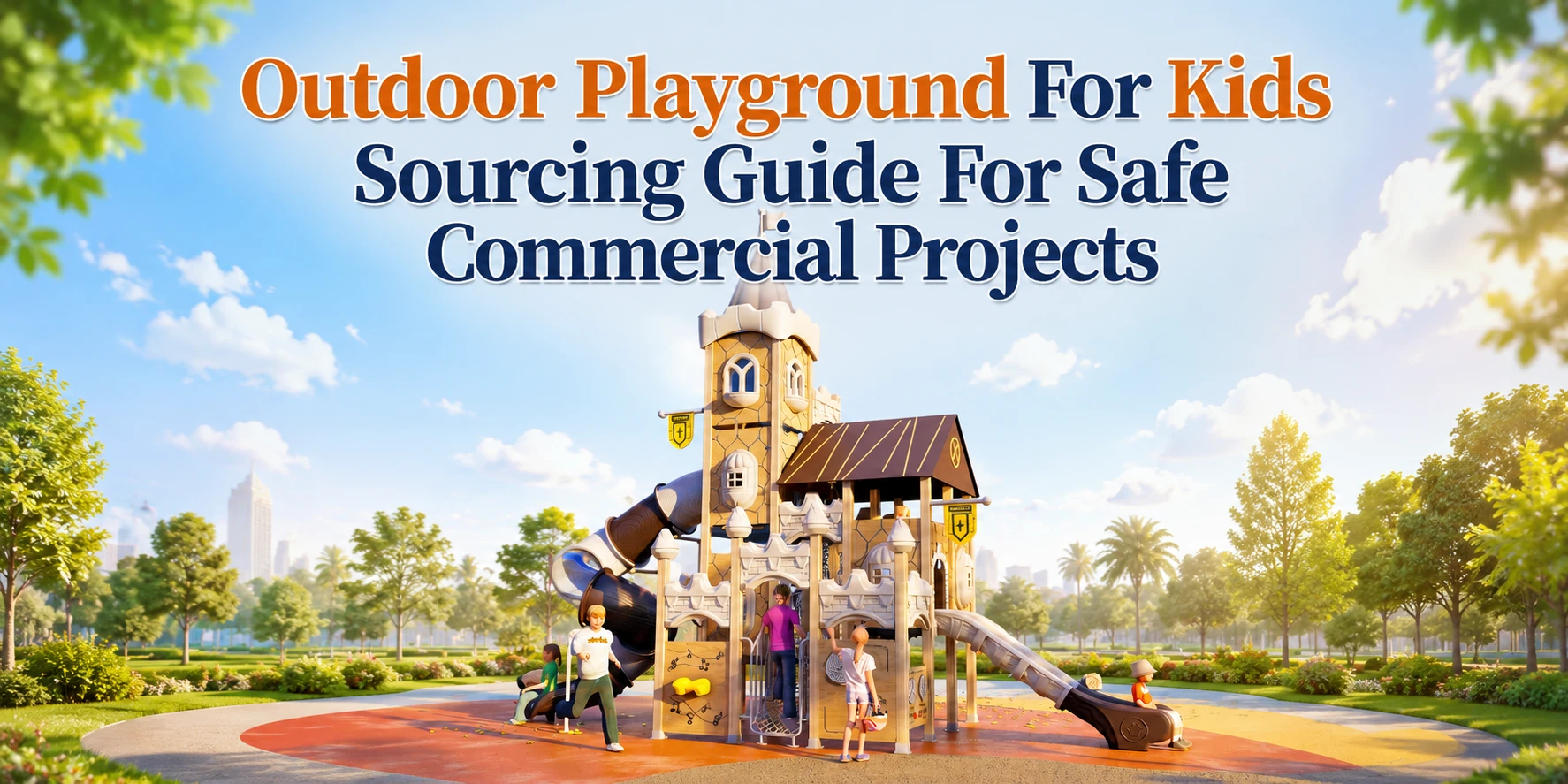
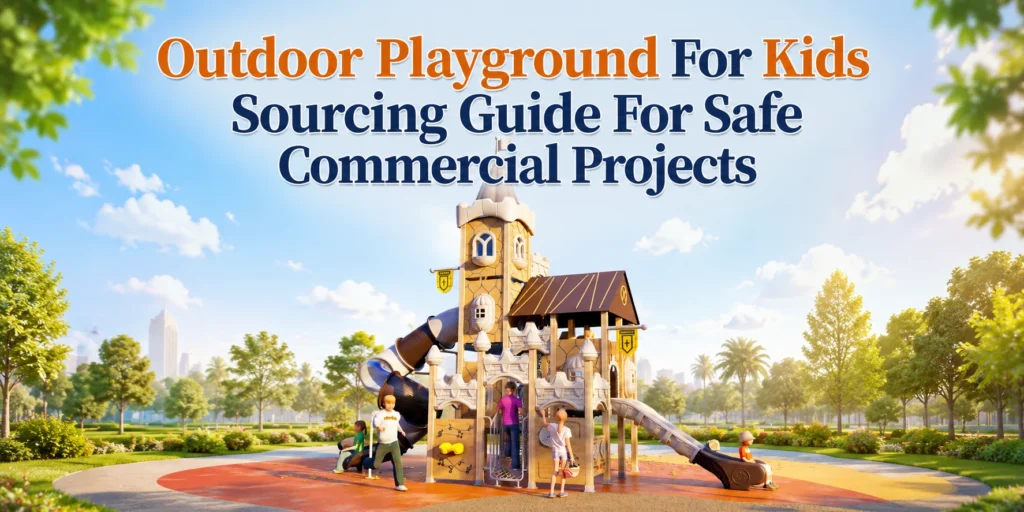
For outdoor playground for kids, buyers need guidance that matches the exact query intent before comparing suppliers, specifications, or RFQ details.
Sourcing outdoor playground equipment for international projects often means juggling three incompatible safety standards at once. You need structures that pass EN1176 in Europe, ASTM F1487 in North America, and AS 4685 in Australia. One certification gap can hold a shipment at customs for weeks.
Outdoor playgrounds for kids are commercial play structures designed for public parks, schools, and recreational areas. They are built to international safety standards covering impact attenuation, entrapment hazards, and structural integrity. Each region enforces distinct testing protocols and material requirements.
This guide covers equipment types, compliance requirements, shipping logistics, and supplier evaluation to streamline your procurement. Global playground sourcing demands a clear checklist from RFQ to final delivery. For buyers seeking a reliable partner, JQ Playground (Wenzhou Jiqi Amusement Equipment Co., Ltd.) has over 30 years of experience in manufacturing and exporting children’s playground equipment. Bulk orders typically take 30–60 days, depending on certification and production capacity.
Types of Outdoor Playground Equipment for Commercial Projects
Four equipment categories dominate commercial playground procurement. Each suits different venues, age groups, and maintenance budgets. Choose based on the intended user capacity and site conditions.
- Modular play systems – Multi-activity structures built from galvanised steel posts and HDPE panels. Typically serve 15–50 children aged 2–12. Lifespan 10–15 years with annual inspections. Ideal for schools and large public parks.
- Freestanding swing sets – Independent swing frames with flexible seats. Accommodate 2–8 users per frame, ages 2–12. Lifespan 8–12 years; moving parts require quarterly checks. Suitable for playgrounds and hotel gardens.
- Water playgrounds – Splash pads with spray nozzles, pumps, and filtration. Materials: stainless steel and UV-stable polymers. Capacity 20–60 children. Lifespan 5–10 years. Common at resorts and community parks.
- Custom-themed structures – Bespoke designs mimicking ships, castles, or animals. Construction uses steel, HDPE, and timber coatings. Ages 3–12, capacity varies. Lifespan 10–15 years but higher maintenance. Preferred by theme parks and high-end resorts.
Suppliers like JQ Playground offer all four categories with custom design services, trial installation before shipping, and compliance with international standards. When sourcing from any playground equipment export supplier, confirm that the product range covers at least two of these categories to reduce multi-vendor coordination.
Why International Certifications Matter for Playground Sourcing
Playground safety standards are not universal. A structure certified for one region may fail import inspection in another. Two primary frameworks dominate global procurement: ASTM F1487 for North America and EN1176 for Europe. Each sets requirements for impact attenuation, entrapment prevention, and structural load. Australia follows AS 4685, closely aligned with EN1176. China enforces GB/T 27689, which adds chemical migration limits and local climate durability tests.
| Region | Standard | Key Tests |
|---|---|---|
| North America | ASTM F1487 | Impact attenuation (HIC ≤ 1000), entrapment probes, structural integrity |
| Europe | EN1176 | Impact damping, entrapment, shearing points, stability under load |
| Australia | AS 4685 | Matches EN1176 with modified fall-height zones for local play values |
| China | GB/T 27689 | Impact tests, corrosion resistance, chemical content limits |
The cost of non-compliance is steep. Shipments can be held for 6–10 weeks while missing test reports are verified. If a child is injured on uncertified equipment, the importer faces liability claims that can reach three times the project value. For any playground equipment importer guide, this is the first check: does the supplier hold current certificates for your target market? A playground equipment distributor sourcing across regions should request third-party test reports, not just a supplier declaration. Manufacturers such as JQ Playground hold certifications including EN1176, ASTM F1487, CPC, and CPSIC, covering multiple regions. Standards are updated every three to five years; certificates older than that may not satisfy border authorities.
Logistics Guide for Cross-Border Playground Shipments
Playground equipment is bulky and often irregularly shaped. Your shipping strategy depends on three variables: how it is packed, which container you use, and who handles each leg. Here is a practical breakdown.
Packing methods
Nearly all commercial playgrounds ship in knock-down (KD) format. Components are disassembled, flat-packed onto pallets, and wrapped for protection. This reduces cargo volume by 40–60 % compared to fully assembled units. Palletization also speeds up customs inspection — your shipment can be scanned without unloading every piece. Fully assembled shipment is rare and usually reserved for small custom-themed structures going directly to a single park.
Container types
– 20‑ft container: holds around 20–25 KD playground sets depending on component size. Suitable for smaller projects or a single school.
– 40‑ft high-cube (HC) container: holds 40–50 sets. Standard choice for bulk orders to parks or multi‑site frame contracts.
Incoterms
– FOB (Free On Board): you take responsibility after the goods are loaded onto the vessel. Lower initial cost but you arrange freight and insurance.
– CIF (Cost, Insurance & Freight): supplier handles export packing, ocean freight, and insurance to your destination port. Preferred for first‑time importers of private label playground equipment or OEM playground export orders.
Step‑by‑step shipping process for a typical bulk order (30–60 days lead time)
- Supplier packs goods in KD format on pallets and provides a packing list with itemised crate numbers.
- You confirm Incoterm (e.g., FOB or CIF) and issue a shipping instruction. Supplier books container space.
- Container loading – supplier loads palletised parts into the selected container, seals it, and issues a bill of lading.
- Customs clearance – supplier submits certificate of origin, bill of lading, commercial invoice, and safety test reports (e.g., EN 1176 or ASTM F1487) to the export customs authority.
- Freight transit – container travels from port of origin to destination. Transit time depends on route; expect 20–35 days for Asia‑to‑Europe or Asia‑to‑North America.
- Import customs release – your broker files the same documents plus a proof of insurance (if CIF). Inspectors may check safety certificates against your country’s required standard.
- Last‑mile delivery – container is delivered to your warehouse or installation site. Unload pallets and cross‑check against the packing list.
Experienced manufacturers like JQ Playground have 20+ production lines that can deliver a 40 ft container within 3 days for standard orders. Their trial installation before shipping helps avoid on-site assembly issues. Average lead time for bulk production plus shipping is 30‑60 days. Rushing to 25 days is possible at a premium – 15 % higher freight cost. Plan your project schedule around this window.
RFQ Checklist: Key Questions for Playground Suppliers
Once you have shortlisted potential suppliers, send a structured RFQ that covers every critical decision point. A vague enquiry returns vague answers. Use this checklist to compare quotes on equal terms.
Certifications held
– Request copies of certificates for EN1176 (Europe), ASTM F1487 (North America), or AS 4685 (Australia).
– Ask if the supplier holds a national GB/T 27689 (China) or equivalent if the project ships to Asia.
– Confirm whether the certification covers the entire kit or only individual components.
Customisation capabilities
– Can the supplier match a specific corporate colour (e.g., Pantone reference) or add a logo on panels?
– For themed playgrounds, ask about custom moulds for characters or landscape shapes.
– Check whether customisation delays the standard lead time by more than 10 days. Some suppliers, like JQ Playground, offer free design support and modifications based on your site CAD file.
Sample policy
– Do they offer a pre-production sample before mass production?
– What is the cost (typically £200–£500 for a small play unit) and lead time?
– Is the sample refundable against the bulk order?
MOQ by product type
– Modular play systems: often 50–100 sets.
– Freestanding swings and slides: 100–200 units.
– Bespoke themed structures: 1–5 units, but with tooling charges.
– Spare parts: no minimum, but ask.
Lead time for design and production
– Standard bulk production is 30–45 days after sample approval.
– Custom designs add 15–20 days for engineering drawings and moulding.
Warranty terms
– Structural frame (steel or aluminium): typical 10 years.
– Plastic panels and moving parts: 2–5 years.
– Surface coating against rust or fading: 1–3 years.
– Ask for the exact exclusion list (e.g., vandalism, natural wear). JQ Playground offers a one-year quality warranty on all products with free after-sales service.
After-sales support
– Does the supplier stock spare parts for at least seven years after the model is discontinued?
– Are installation manuals available in English, French, or Arabic?
– Do they provide a video guide or on-site technician (for large projects only)? JQ Playground can send engineers to assist with installation.
Recent project references
– Request three to five reference projects completed in the past 12 months, with photos or site videos.
– Prefer projects in your target region (same climate zone, same safety inspectors).
Packaging specifications
– Confirm that parts are knockdown-packed on pallets, labelled by section, and wrapped for sea freight.
– Ask for the exact carton dimensions and weight per pallet to calculate playground shipping and packing costs accurately.
– Clarify the playground Incoterms used — FOB (factory-loaded) or CIF (delivered to port) — and whether the price includes export packing.
Send this checklist as an Excel template so suppliers fill each field. You can then rank quotes by total cost, lead time, and compliance confidence in one glance.
About JQ Playground – globalplaygroundsource.com
JQ Playground (Wenzhou Jiqi Amusement Equipment Co., Ltd.) is a children’s playground equipment manufacturer founded in 1993. The company provides design, customization, large-scale manufacturing, sales, installation guidance, and after-sales support for outdoor playgrounds, indoor playgrounds, soft play, water playgrounds, PE board playgrounds, kindergarten furniture, outdoor fitness equipment, pet playgrounds, and playground facilities. Approved company facts include 180+ employees, a large Wenzhou production base, 20+ production lines, 55 production machines, ISO/BSCI/EN1176/EN71/ASTM/CPC/CPSIC certification references, 100+ patents, free design support, OEM/ODM capability, trial installation before shipping, export experience, and one-year quality warranty.