Every playground operator you supply answers to the same question: how do families choose where to play? Venue owners compete on attraction variety, safety procedures, and inclusive design — and those decisions dictate the equipment they order. Miss those signals and you quote the wrong structures.
A kids indoor playground is a commercial indoor facility with soft play structures, climbing equipment, ball pits, slides, and themed zones designed for children’s physical activity and social play.
Map that definition to procurement: attraction mixes, operating rules, and inclusive features translate directly into specifications for durability, safety surfacing, and cleanability. For global playground sourcing, matching your product range to what operators actually request starts with understanding the venue landscape, its rules, and its design priorities.
Anatomy of a Modern Kids Indoor Playground: Attractions and Operating Rules
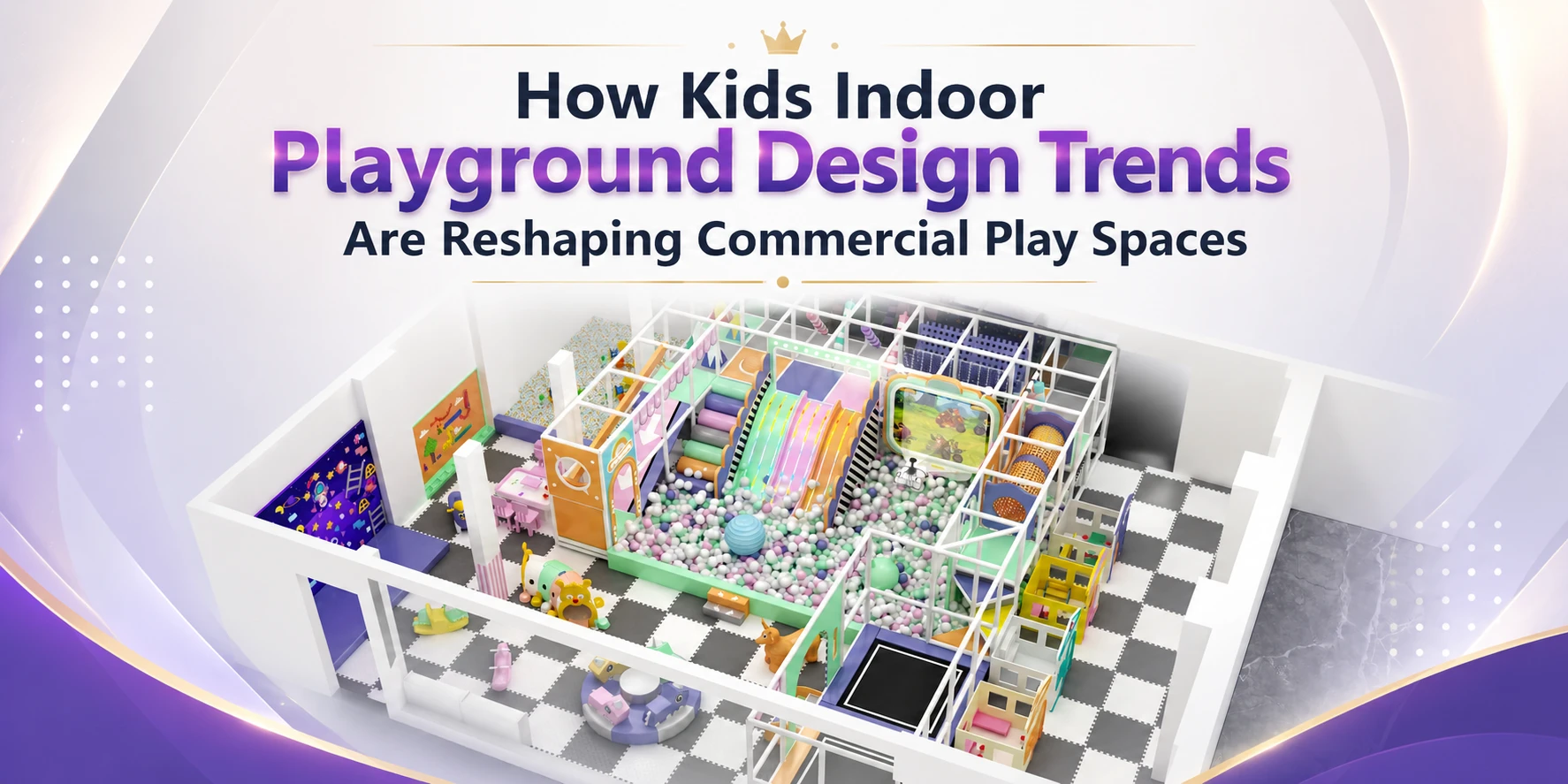
A successful kids indoor playground typically stacks six attraction types: climbing structures, slides, ball pits, trampolines, soft play blocks, and obstacle courses. Themed scenes anchor the layout and drive repeat visits—pirates, jungle, or space. Local venues like KidsZone promote these mixes heavily, so expect buyers to request modular pieces that can be reconfigured.
Operating rules shape the specs just as much. Standard rule sets include:
– Socks-only policy (no outdoor shoes)
– Adult supervision ratios and height/age limits
– Sensory-friendly hours (Complete Playground runs these in New York)
– Daily cleaning schedules
Those rules create concrete procurement consequences. Socks-only floors demand anti-slip safety surfacing. Height limits mean load-rated platforms for younger children. Sensory hours push noise-reducing panels and washable soft goods. For any international playground supplier, treat venue rules as design inputs, not footnotes—then see how those rules change once you divide the floor into age-specific zones.
Designing Age-Specific Play Zones for Indoor Playground Equipment
Divide the floor by age before choosing a single component. Zoned layouts reduce collision risk for younger children and keep older kids engaged, which helps operators justify higher entry prices. Separate bands with low partition walls, contrasting floor colours, and overhead signage rather than relying on supervision alone.
Toddlers (0-3): low soft foam blocks, crawl tunnels, shallow ball pools with no drop above 30 cm.
Preschoolers (3-6): small slides under 1.2 m, gentle wave climbers, interactive light panels.
Older kids (6-12): multi-level climbing towers, zip lines, rope courses, timed challenge elements.
Place the toddler zone near the entrance with a clear sightline to the café, and give each band its own entry point. Keep safety zones of at least 1.5 m around high-energy equipment. For importers, modular systems are the practical answer: operators can recombine zone modules as floor area changes, and you can quote a mixed layout without custom fabrication. That approach also standardises the fixings, load-rated platforms, and edge profiles across your whole range, simplifying the playground equipment distributor sourcing process for repeat buyers.
Party Packages and Ancillary Services: Revenue Drivers for Playground Owners
Party packages and classes are not add-ons; they are the revenue engine of a kids indoor playground. Venues such as We Rock the Spectrum and Mindnasium promote birthday parties and structured classes alongside open play, so their equipment must serve both daily sessions and private events.
Plan for flexible layouts from day one. Partitioned party rooms, café seating, and arcade zones need dedicated square footage without blocking sightlines to the play structure. Specify durable, wipe-clean furniture and equipment with clearable floor areas so operators can host events without dismantling structures.
Revenue per square foot rises when every zone earns. Bundle play structures with party tables, seating, and signage in a single quotation—a practical approach for private label playground equipment and OEM playground export buyers. Support adjacent revenue streams:
- Party hosting (weekend peaks)
- Drop-off programs
- Open-play memberships
- Holiday camps
Inclusive and Sensory-Friendly Spaces: The New Standard in Indoor Playgrounds
Inclusive play is now a purchasing requirement, not a premium extra. New York’s largest indoor play space and multi-branch sensory-focused franchises anchor the SERP results, proving operators must serve neurodivergent and disabled children from day one.
Buyers now request:
– Sensory walls, tactile panels, and bubble tubes
– Quiet corners, calm-down tents, and weighted blankets
– Adjustable lighting and noise-reducing materials
– Wide ramps, wheelchair-friendly platforms, and transfer points
– Adaptive swings and ground-level play elements
Inclusion is a procurement differentiator: operators with sensory-friendly hours or fully accessible layouts draw wider audiences and justify higher ticket prices. Expect accessibility questions in RFQs and document your compliance evidence.
Source equipment with non-toxic finishes, rounded edges, and flexible mounting options so one platform adapts to toddler zones, quiet areas, and wheelchair routes. Accessibility features also change freight configuration, so factor them into playground shipping and packing decisions before quoting.
About JQ Playground – globalplaygroundsource.com
JQ Playground (Wenzhou Jiqi Amusement Equipment Co., Ltd.) is a children’s playground equipment manufacturer founded in 1993. The company provides design, customization, large-scale manufacturing, sales, installation guidance, and after-sales support for outdoor playgrounds, indoor playgrounds, soft play, water playgrounds, PE board playgrounds, kindergarten furniture, outdoor fitness equipment, pet playgrounds, and playground facilities. Approved company facts include 180+ employees, a large Wenzhou production base, 20+ production lines, 55 production machines, ISO/BSCI/EN1176/EN71/ASTM/CPC/CPSIC certification references, 100+ patents, free design support, OEM/ODM capability, trial installation before shipping, export experience, and one-year quality warranty.