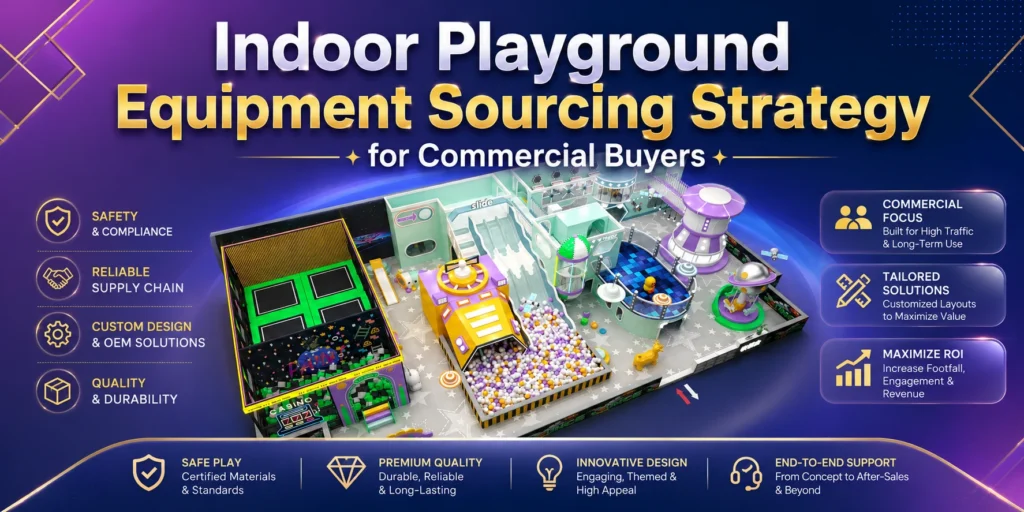
Indoor playground equipment has become a major purchasing category for importers, distributors, private-label buyers, and contractors serving public venues. Indoor playground equipment includes commercial-grade playsystems, soft play modules, climbing structures, themed play structures, and toddler zones designed for malls, family entertainment centres, daycare facilities, and hotels.
Buyers sourcing across multiple countries need clear guidance on product types, compliance paperwork, and custom theming before committing to a supplier. The sections that follow walk through what procurement teams should verify at each stage of the sourcing process.
Indoor Playground Equipment Types for Commercial Projects
Commercial sourcing of indoor playground equipment typically falls into six repeatable categories.
- Soft play modules — foam shapes, ball pools, and obstacle blocks that suit younger children and high-traffic venues.
- Climbing structures — jungle gyms, wall bars, and rope nets that build vertical play.
- Slides and tubes — straight, spiral, and tunnel options that connect levels and manage flow.
- Themed playhouses — castle, nature, or shop-front units for role-play zones.
- Toddler areas — low-height platforms, crawlers, and gentle ramps for ages under three.
- Sensory panels — interactive boards with lights, sounds, and tactile elements.
Most projects combine several types into one layout: a climbing core with slides, a soft-play floor, and a themed toddler zone at the perimeter. This matches how leading suppliers organise their catalogs — jungle gyms, soft play, and themed indoor play are the main procurement categories. Next: compare commercial-versus-home durability.
How to Compare Commercial and Home Indoor Play Equipment
| Factor | Commercial-grade | Residential |
|---|---|---|
| Frame build | Welded steel or reinforced aluminium | Bolt-together plastic tubing |
| Material thickness | 12–15 mm HDPE; dense commercial foam | Thin moulded panels |
| Weight limits | Group-load ratings per platform | Single-child estimates |
| Fire retardance | Certified fire-rated materials | Rarely rated |
| Maintenance cycle | Daily checks; replaceable wear parts | Occasional cleaning |
| Modularity | Expandable and reconfigurable | Fixed footprint |
| Compliance paperwork | ASTM, EN1176, CE documentation | None issued |
Residential sets work in living rooms, not public venues. They lack the structural margins, fire ratings, and weight certifications that inspectors and insurers expect. If a home-grade unit fails in a daycare or entertainment centre, you carry the liability.
So source from suppliers who manufacture to commercial specifications from the start. Put material thickness, load-test data, and certification files on your RFQ checklist. A comparison table like this belongs in any playground equipment importer guide you build for your procurement team; it keeps decisions disciplined and vendors accountable. Next, we examine the safety standards behind those certification files.
Safety Standards and Compliance for Indoor Playground Equipment
Those certification files trace back to two frameworks importers see most often: ASTM F1918 for soft-play equipment in North America and EN1176 for public playground equipment across Europe. Both target the same core risks, so verify each one against your destination market.
Age zoning drives design. Toddler areas for under-36-month-olds need lower platforms and tighter barriers than school-age zones, while EN1176 sets critical fall heights for impact-absorbing surfaces. Check for rounded edges and gaps that prevent entrapment or pinch-point injuries. Materials must pass toxicity screening, and foam components should meet the flame-retardancy rules of each target country.
Ask suppliers for these documents:
– US: ASTM F1918 test report
– EU: EN1176 compliance with CE marking
– UK: EN1176 with UKCA marking
– Australia: AS 4685 playground standard
Insist on third-party reports. For private label playground equipment, the certificate must match your brand’s model number, not a generic factory reference.
Custom Theming and Modular Design of Indoor Playground Equipment
For malls and family entertainment centres, custom-themed indoor playground equipment is a procurement spec, not an aesthetic extra. Supplier theme packages cluster into four families:
- Nature: trees, animals, foliage
- Castle: towers, bridges, slides
- Space: rockets, planets, glow panels
- Ocean: waves, ships, sea life
SERP listings confirm dedicated themed indoor play equipment suppliers and soft play manufacturers offer custom design as a core service.
For private-label buyers, integrate logo and brand colours into panels and entrance arches. Moulded graphics outlast vinyl decals under repeated cleaning.
Modular layouts adapt to the building: a 2.5-metre ceiling suits low-level climbers; a 6-metre atrium supports multi-level towers. Before quoting, request 3D renderings or a virtual walkthrough to check sightlines and supervision zones. Attach floor plans, ceiling height, column positions, and door widths to the RFQ.
About JQ Playground – globalplaygroundsource.com
JQ Playground (Wenzhou Jiqi Amusement Equipment Co., Ltd.) is a children’s playground equipment manufacturer founded in 1993. The company provides design, customization, large-scale manufacturing, sales, installation guidance, and after-sales support for outdoor playgrounds, indoor playgrounds, soft play, water playgrounds, PE board playgrounds, kindergarten furniture, outdoor fitness equipment, pet playgrounds, and playground facilities. Approved company facts include 180+ employees, a large Wenzhou production base, 20+ production lines, 55 production machines, ISO/BSCI/EN1176/EN71/ASTM/CPC/CPSIC certification references, 100+ patents, free design support, OEM/ODM capability, trial installation before shipping, export experience, and one-year quality warranty.