Specifying play equipment for a school, park or housing project means balancing durability, safety and budget. One weak component can fail within a season, and replacements rarely match the original order.
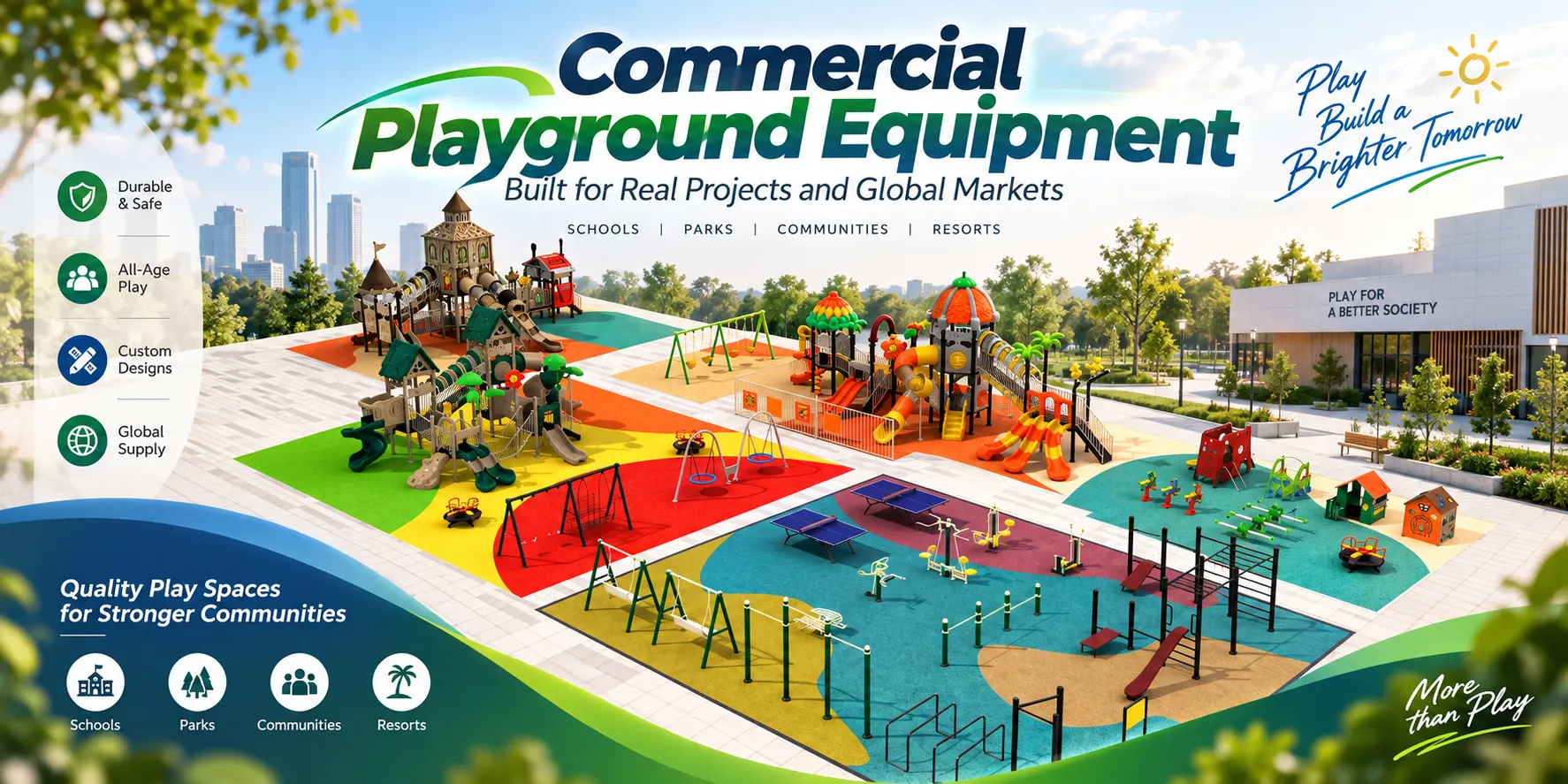
Commercial playground equipment covers heavy-duty play structures built for continuous public use: steel, aluminium and HDPE components rated for higher loads, longer duty cycles and mixed age groups.
The sections below cover categories, build differences, venue applications and global playground sourcing steps that shape a project specification.
Commercial Playground Equipment Categories: Play Structures, Swings, Climbers, and Activity Panels
Buyers working with an international playground supplier typically shortlist eight core groups:
- Play structures — linked decks, towers and platforms that carry slides, roofs and access points as one modular system.
- Slides — straight, spiral or tube formats, sized by deck height and age band.
- Swings — belt, bucket or nest seats on single or multi-bay frames.
- Climbers — net, rope, rock-wall and ladder units.
- Tunnels and bridges — connectors that extend a structure and add crawl-through play.
- Activity panels — tic-tac-toe, gear and music boards at standing or seated height.
- Overheads — trapeze, monkey bars and track riders for hanging travel.
- Sensory and inclusive pieces — tactile or wheelchair-accessible units placed beside busy zones.
Timber and steel systems are a portfolio choice, not a rank order: wood suits natural park settings, and powder-coated steel suits high-frequency school yards.
What Separates Commercial-Grade Playground Equipment from Residential Playsets
Category choice settles what you sell; build grade settles where you can sell it. A residential playset is built for one household and a few children at a time. A commercial frame answers to full classes, day after day.
| Criteria | Residential playset | Commercial-grade unit |
|---|---|---|
| Frame and finish | Thin-wall tube or timber, spray-painted | Thick-wall steel or aluminium, welded joints, powder-coated |
| Plastics and moving parts | Consumer-grade HDPE, light hangers | UV-stabilised HDPE, sealed swing bearings |
| Use pattern | 1–2 hours daily, seasonal, stored indoors | 8–12 hours daily, year-round, drainage built in |
| Inclusive design | Rare | Ramps, transfer stations, ground-level sensory pieces |
A playground equipment importer guide usually puts grade above price, because one is not a substitute for the other. Inclusive add-ons then shape layout: a ramp needs a clear approach route, not just floor space. Daily load patterns differ by venue, so a single structure often ships in several configurations.
Where Commercial Playground Equipment Is Used Across Schools, Parks, and Community Projects
Who signs off the layout changes the specification. A parks department, a school board, and a property manager each brief a project differently.
- Public parks and municipalities: multi-age structures, generous fall zones, and long service life with replaceable parts.
- Schools: zoned layouts splitting junior and senior play, with accessible routes linking each cluster.
- Daycares and nurseries: compact decks, low platforms, fenced footprints, and clear supervisor sightlines.
- Churches and community centres: dual-use areas that switch between weekday childcare and weekend gatherings.
- Apartment complexes: space-efficient towers, shaded bays, and quieter components near homes.
- Campgrounds and resorts: weather-tolerant timber or steel mixes spread over uneven ground.
Schools in one country rarely match those in another. Deck heights, fall zones, and colour choices shift by market, so one tender may need three layout variants. Repeat orders follow the same pattern — one municipal site often leads to two more asking for matching components.
Custom and Private-Label Playground Equipment Programs for Importers and Distributors
Distributors rarely sell a catalogue exactly as it arrives. They sell a local version of it — which is where custom and private-label programs do the work.
- Custom themes: swap standard roofs, panels, and toppers for region-specific motifs — castle, space, farm, harbour.
- Colours: powder-coat shades matched to a school palette or a national flag.
- Branded components: your logo cast into panels, printed on signage, or applied as decals.
- Modular configurations: the same frame takes 3, 5, or 7 deck sections, so one design covers several price tiers.
- Private-label/OEM: your own product names and artwork, built against a shared specification.
A buyer’s design brief drives selection. Ask for theme, palette, deck height range, age group, and budget band, and the shortlist narrows fast.
Example: a distributor in a coastal market replaced a generic slide hood with a lighthouse panel and blue-grey posts to match a harbour-front brief.
Sourcing and Export Planning for Multi-Country Commercial Playground Projects
Once a design brief is signed off, logistics decides the schedule. Work through these steps before releasing a purchase order.
- Specification review. Confirm post diameters, deck heights and component counts against each site plan.
- Site layout coordination. Check module footprints, access points and fall-zone clearances; a 6 m × 6 m structure needs more ground than its own footprint.
- Packing. Ask for packed CBM per site. Flat-packed posts and panels typically let one 40 ft HC hold two or three small layouts; pre-assembled frames cut that to one.
- Incoterms. FOB suits buyers using their own forwarder; CIF or DAP moves port handling to the supplier.
- Customs paperwork. Playground equipment customs documents differ by market: EU importers expect a commercial invoice showing HS heading 9506.99, a packing list and a bill of lading, while Gulf destinations often add legalised invoices and Arabic outer labels.
- Lead times. Allow 30–45 days production plus 20–35 days transit, then schedule multi country playground projects in delivery waves.
Nail these six points and site handover follows cleanly.