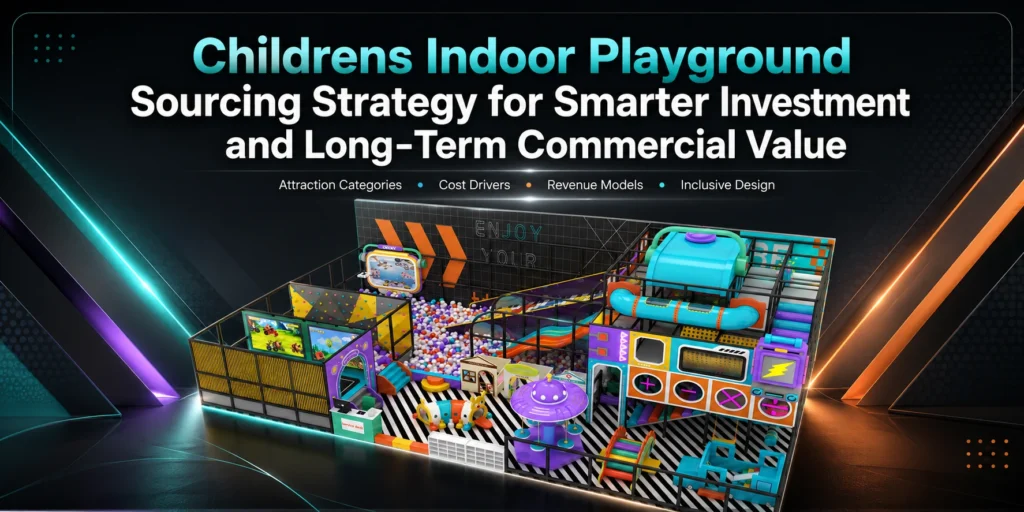
Sourcing equipment for a children’s indoor playground demands more than picking slides and ball pits. Buyers must weigh commercial categories, cost drivers, and operator revenue models. A children’s indoor playground is a commercial play facility that combines climbing structures, slides, tunnels, obstacle courses, and other age-specific attractions under one roof. Each attraction type carries a different footprint, price point, and wear profile. The following sections use observed venue offerings and investment patterns to guide your equipment procurement decisions.
Commercial Indoor Playground Attractions: Categories Buyers Need to Know
Buyers comparing commercial venues will see the same recurring categories. Each has a distinct floor-plan demand, age focus, and maintenance profile, so use them to set material and safety specifications.
- Multi-level climbers: plan 100–150 m²; ages 4–12; netting, connection clamps, and ladder rungs take the heaviest daily stress.
- Slides: straight, spiral, and tube versions need extra ceiling clearance; ages 3–10; exit lips and ladder steps wear first.
- Tunnel crawls: compact links between zones; ages 2–8; mesh or fabric panels show abrasion fastest.
- Obstacle courses: timed racing layouts occupy 80–120 m²; ages 5+; grip surfaces and edge padding degrade fastest.
- Trampolines: open beds or recessed jump pads require perimeter fall padding; ages 3–12; mats and springs fail most often.
- Toddler zones: low-level soft play for under-3s; foam blocks and ball pits need frequent replacement and sanitising checks.
- Arcade/game areas: redemption machines need 20–50 m²; ages 5+; buttons, joysticks, and ticket dispensers fail most often.
Share these wear profiles with a playground equipment export supplier before comparing cost benchmarks.
Indoor Playground Cost Drivers and Investment Benchmarks
Venue pages reveal that square footage drives the equipment budget most. A 5,000 sq ft facility with a multi-level climber and trampoline zone costs more than a 3,000 sq ft soft-play centre, even with a similar supplier list. Attraction count and complexity change the steel mass, netting volume, and installation hours. Ceiling height limits tower designs; fall height sets safety surfacing depth; HVAC loads grow with enclosed structures. Party rooms and cafe space rarely raise the equipment line, but they shrink the playable footprint.
| Cost Driver | Impact | Key Specification Questions |
|---|---|---|
| Square footage | High | What playable area must the equipment fill? |
| Attraction complexity | High | How many climbers, slides, and trampolines are planned? |
| Ceiling and fall height | Medium | What safety surfacing depth does the design require? |
| HVAC and building services | Medium | What ventilation load will the play structure create? |
| Party rooms and cafe | Low | Do these zones reduce the equipment footprint? |
Benchmark quotes by comparing equipment cost per square foot against observed venue sizes. Do that before you commit to a playground equipment distributor sourcing plan.
Memberships, Admissions, and Parties: What Operator Revenue Models Mean for Equipment
Playbliss membership passes and Hyper Kidz party packages show how operators monetise repeat visits. Daily admissions spread demand thinly; memberships concentrate it into predictable, high-frequency play. That pattern changes your equipment specification.
High-cycle use accelerates wear-and-tear, so specify:
– Sturdier materials on slides, climbers, and ball-pit frames rated for continuous operation.
– Certified safety surfacing under elevated structures to handle peak-hour queues.
– Modular replaceable parts so worn panels and connectors swap quickly without replacing whole units.
Party packages add a second requirement: flexibility. Booked private events need flexible floor plans, themed customisation options, and separate food and beverage zones so play areas convert between open play and celebration layouts. Revenue models therefore drive structural durability and spatial design, and those spatial choices also determine how easily a playground serves different user groups.
Inclusive and Sensory-Friendly Playground Design in Equipment Sourcing
Inclusive and sensory-friendly design is no longer a niche add-on when sourcing equipment for a childrens indoor playground. For many public, education, and non-profit buyers, it is now a procurement requirement. Children with mobility challenges need accessible platforms and wide transfer points between levels. Neurodivergent users often need quieter zones where noise and light intensity can drop without interrupting the play flow.
Suppliers serving this niche should offer:
- Accessible ground-level platforms and ramped routes between climber levels
- Quiet corners with soft seating and dimmable lighting for sensory breaks
- Tactile panels, textured walls, and audio components that provide adjustable stimulation
- Soft-play elements with visual cues such as colour contrast or bubble tubes to signal transitions
- Layouts with clear sightlines so carers can supervise from multiple angles
Equipment that supports adjustable intensity — from low-stimulation quiet zones to high-energy climbing areas — makes a facility genuinely usable for both neurotypical and neurodivergent children.
About JQ Playground – globalplaygroundsource.com
JQ Playground (Wenzhou Jiqi Amusement Equipment Co., Ltd.) is a children’s playground equipment manufacturer founded in 1993. The company provides design, customization, large-scale manufacturing, sales, installation guidance, and after-sales support for outdoor playgrounds, indoor playgrounds, soft play, water playgrounds, PE board playgrounds, kindergarten furniture, outdoor fitness equipment, pet playgrounds, and playground facilities. Approved company facts include 180+ employees, a large Wenzhou production base, 20+ production lines, 55 production machines, ISO/BSCI/EN1176/EN71/ASTM/CPC/CPSIC certification references, 100+ patents, free design support, OEM/ODM capability, trial installation before shipping, export experience, and one-year quality warranty.