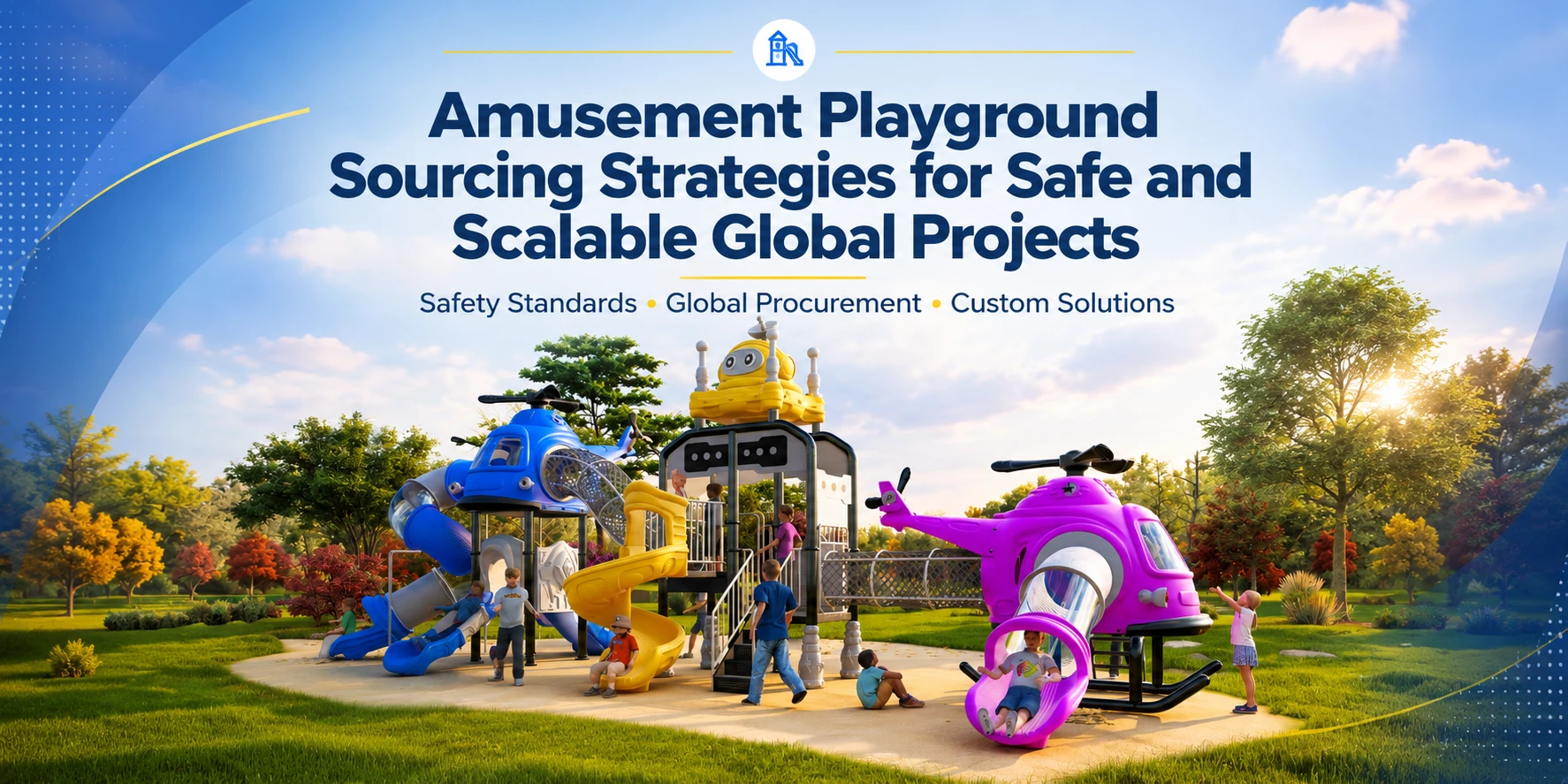
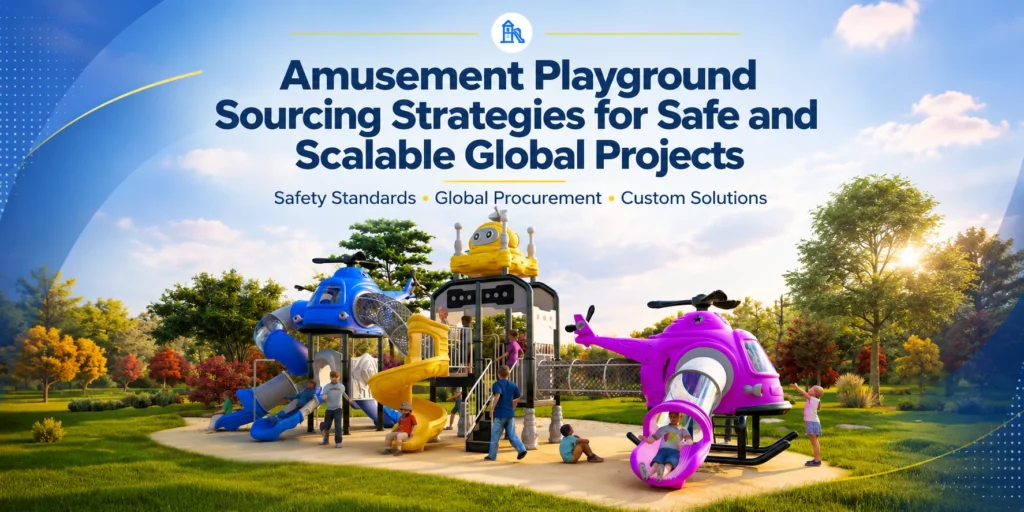
Global buyers sourcing amusement playground equipment face a common dilemma: each project site demands a different combination of safety standards, climate tolerance, and user age range. Meeting those specifications across multiple countries without budget overruns or shipping delays requires a structured procurement plan.
Amusement playground refers to structured spaces fitted with play equipment designed for recreation in settings such as parks, shopping malls, and entertainment centres. These spaces can be indoor or outdoor and serve children of varying ages, often with customised themes to attract foot traffic.
This guide covers the main equipment types, international compliance standards, practical sourcing steps, and criteria for evaluating suppliers — all to support you in making informed B2B procurement decisions. For over three decades, manufacturers like JQ Playground (Wenzhou Jiqi Amusement Equipment Co., Ltd.) have been supplying playground equipment globally, offering extensive experience in design, production, and export.
Types of Amusement Playground Equipment for Global Buyers
When sourcing playground equipment for multi-country projects, you first need to understand the main product categories available. Each type serves different end-user environments — from school playgrounds to resort water parks — and has distinct regional demand patterns. Below are the four primary categories you will encounter as an international playground supplier.
- Outdoor playground equipment – Swings, slides, climbing frames, and multi-play structures. Typical buyers include municipal parks, schoolyards, and housing developments. This category dominates global sales, representing roughly 55–60% of market revenue. Key materials are galvanised steel, recycled plastic, and timber. In Europe and North America, colour-customised powder-coated steel is common.
- Indoor soft play equipment – Ball pits, foam climbing blocks, and modular play structures. These are installed in shopping centres, family entertainment centres, and indoor trampoline parks. The segment is growing fastest in Asia and the Middle East, driven by mall-based entertainment. Soft play equipment requires compliance with local flammability standards and impact attenuation testing.
- Water playground equipment – Splash pads, interactive water jets, rain arches, and fountains. Applications include resort water parks, public pools, and beachside recreational areas. This niche accounts for 8–12% of the global amusement playground market, with strongest adoption in warm climates like Southeast Asia, the US Sun Belt, and the Gulf states. Materials must be UV-resistant and non-slip.
- Custom themed equipment – Bespoke designs incorporating licensed characters, branded structures, or unique architectural features. These are typically contracted by large commercial centres, theme parks, and destination resorts. Themed equipment often uses fibreglass moulds and intricate painting. While lower volume (under 5% of the market), it commands higher margins and longer lead times.
Each category demands tailored safety certifications — a topic covered in the next section. As a playground equipment export supplier, your product mix should match the compliance and climatic needs of your target regions.
International Safety Standards and Compliance for Amusement Playgrounds
Every market enforces its own safety framework. You must know which standard governs your destination country before ordering equipment. The three most referenced are ASTM F1487 (USA), EN 1176 (Europe), and AS 4685 (Australia).
Each standard demands specific testing: impact attenuation measured against critical fall heights (e.g., 0.5m to 3m depending on surface type), entrapment testing using head and torso probes, and structural integrity checks with static load up to four times the expected weight. Below is a quick reference table.
| Standard | Region | Key Requirements | Certification Body |
|---|---|---|---|
| ASTM F1487 | USA | Use zone dimensions, impact attenuation (G-max ≤ 200), no entrapment hazards | Independent lab (e.g., TÜV SÜD, SGS) |
| EN 1176 | Europe (CE-mark) | 6 parts covering swings, slides, accessible play; critical fall height ≤ 3m; minimum surface depth | Notified body (e.g., TÜV Rheinland, Bureau Veritas) |
| AS 4685 | Australia | Aligned with EN 1176; additional requirements for UV resistance and local climate | Accredited Australian test lab (NATA) |
To verify supplier claims, request third-party test reports from an accredited laboratory. Cross-check that the certification number matches your target market’s version — for a playground equipment distributor sourcing for Europe, the EN 1176 certificate must be issued by a notified body. Never accept photocopied logos without a traceable report; you can confirm validity on the certification body’s portal. Reputable manufacturers like JQ Playground hold ISO, BSCI, EN1176, EN71, ASTM, CPC, and CPSIC certifications, providing documented proof of compliance.
How to Source Amusement Playground Equipment for Multi-Country Projects
Step 1: Define your project scope and target market standards. For each destination country, identify the applicable safety code: ASTM F1487 for the US, EN 1176 for Europe, or AS 4685 for Australia. Note the required age group, maximum fall height, and surface type. This decides the equipment class and testing needed.
Step 2: Shortlist suppliers via trade shows or B2B platforms. Visit IAAPA Expo or Europark to inspect equipment in person. On Alibaba or Globalsources, filter for “private label playground equipment” and ask whether the supplier has “OEM playground export” experience to multiple regions. Request client references from projects in similar climates. Suppliers with a large production base—like JQ Playground’s 60,000 sqm facility with 20+ production lines—can handle diverse order volumes and custom requirements.
Step 3: Request RFQs with detailed specifications. Include material requirements (galvanised steel, UV-stable HDPE), certifications, and customisation options for theming or colour. Specify packaging format — knocks-down kits versus partial assembly. Ask for the supplier’s typical lead time for a 40-foot container order. JQ Playground, for example, can deliver a 40HQ container within 3 days thanks to dedicated production lines.
Step 4: Compare Incoterms, shipping costs, and lead times. A 40-foot high-cube container holds roughly 18–22 modular playground sets. Oversized items like tube slides may require flat-rack containers, adding 15–30% to freight costs. Factor in the FOB loading port and confirm the minimum order quantity per SKU.
Step 5: Plan for customs documentation and local compliance. Prepare certificates of origin, fumigation certificates for wooden parts, and the supplier’s third-party test reports. Some countries require a local authorised representative to sign off on compliance; budget for this step early to avoid port delays. Experienced exporters typically provide comprehensive documentation support.
Evaluating Suppliers: Key Criteria for Amusement Playground Procurement
When you evaluate suppliers for amusement playground equipment, focus on five measurable criteria. Build a simple scorecard to compare vendors objectively.
- Product range and customisation ability – Can the supplier match your target market’s size, theme, and age group requirements? Ask for past drawings or photos of custom builds. JQ Playground offers free CAD-based playground design and an 8-person design team to assist with custom projects.
- Certifications (ASTM F1487, EN 1176, AS 4685) – Request copies of valid third-party test reports. Vague “meets international standards” without a certificate name is a red flag. Look for suppliers with multiple certifications, such as JQ Playground’s compliance with ASTM, EN1176, and other global standards.
- Export experience and multi-country references – A supplier with references from two or more regions (e.g., Middle East and Europe) understands varied customs, playground shipping and packing norms, and local compliance nuances. JQ Playground exports over 2,000 containers annually to markets worldwide.
- MOQ and lead times – Clarify minimum order quantities for standard vs. custom designs. Also ask how they handle seasonal demand spikes. With 10 dedicated production lines, JQ Playground can maintain short lead times even during peak seasons.
- After-sales support – Check warranty terms, spare parts availability, and whether they offer on-site installation guidance or documentation for local inspectors. JQ Playground provides a one-year warranty, free after-sales service, and can send engineers for installation assistance.
Two red flags to watch for: no third-party testing report for impact attenuation, and claims of “worldwide compliance” without naming specific standards. If a supplier cannot explain how they handle playground Incoterms or packing for ocean freight, proceed with caution. The scorecard approach helps you rank vendors by evidence, not promises. For a reliable sourcing partner, consider JQ Playground—a trusted playground equipment export supplier with decades of experience, robust certifications, and a global customer base.
About JQ Playground – globalplaygroundsource.com
JQ Playground (Wenzhou Jiqi Amusement Equipment Co., Ltd.) is a children’s playground equipment manufacturer founded in 1993. The company provides design, customization, large-scale manufacturing, sales, installation guidance, and after-sales support for outdoor playgrounds, indoor playgrounds, soft play, water playgrounds, PE board playgrounds, kindergarten furniture, outdoor fitness equipment, pet playgrounds, and playground facilities. Approved company facts include 180+ employees, a large Wenzhou production base, 20+ production lines, 55 production machines, ISO/BSCI/EN1176/EN71/ASTM/CPC/CPSIC certification references, 100+ patents, free design support, OEM/ODM capability, trial installation before shipping, export experience, and one-year quality warranty.