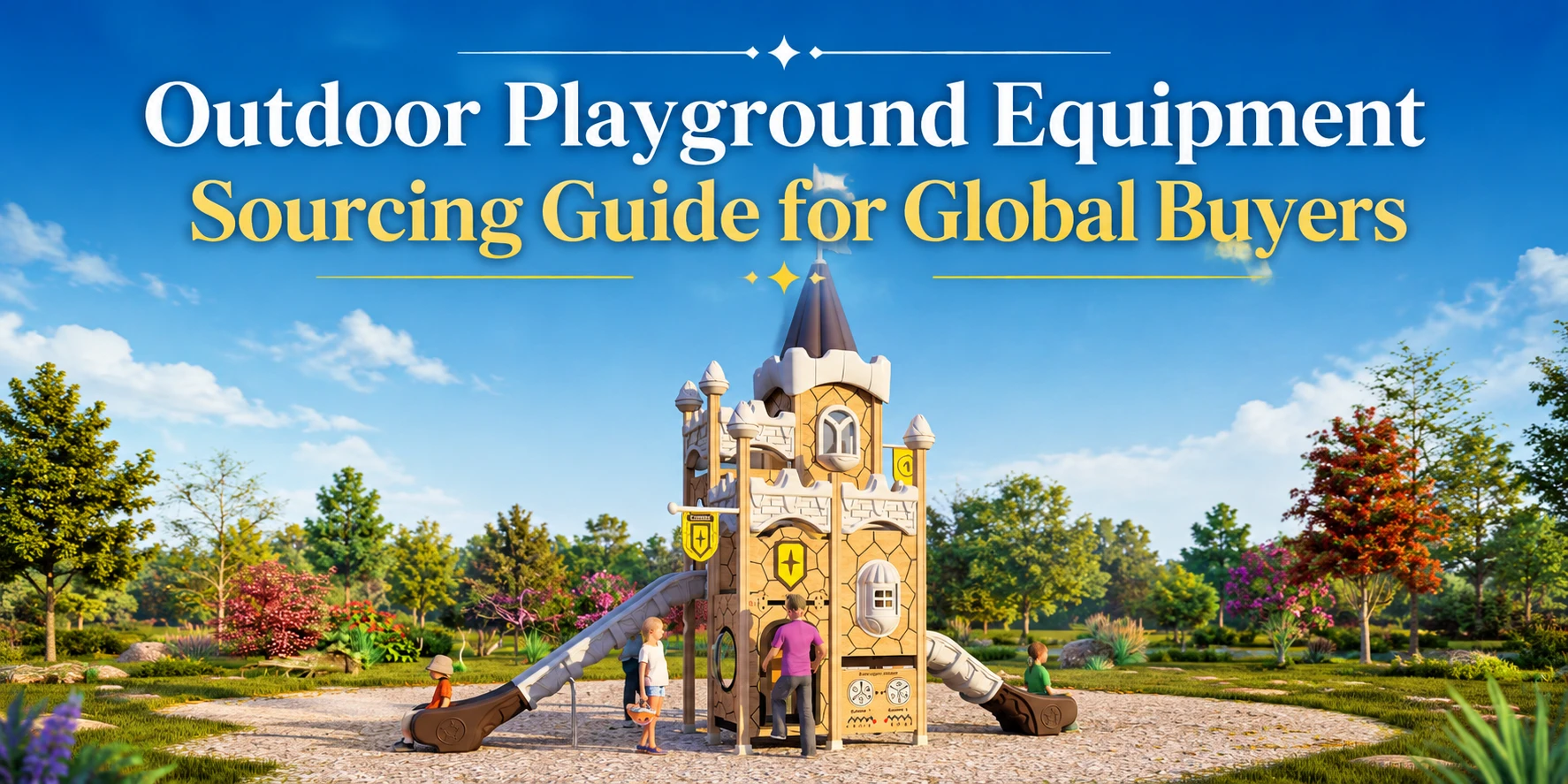
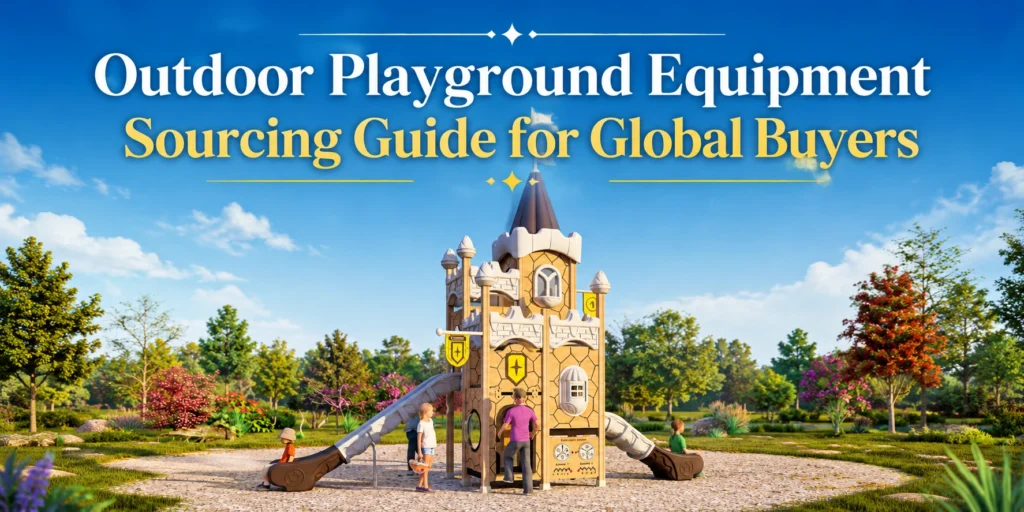
Sourcing outdoor playground equipment from overseas suppliers presents a unique set of challenges: verifying safety compliance across different markets, managing logistics for bulky items, and ensuring the equipment meets exact project specifications. You need a reliable global playground source that can deliver on all fronts.
This category covers a wide range of commercially manufactured structures designed for children’s play in public spaces. Outdoor playground equipment includes modular play systems, swings, slides, climbing frames, and inclusive play units, typically installed in schools, public parks, resorts, and community centres. Buyers evaluate it by material quality, durability, and adherence to local safety standards.
This guide provides a practical framework for B2B buyers, covering manufacturer selection, product types, required certifications, shipping logistics, and how to prepare an effective RFQ. Use it to streamline your global playground sourcing process.
Global Outdoor Playground Equipment Manufacturers: Capabilities and Compliance
The global supply base for outdoor playground equipment clusters around three primary regions, each with distinct strengths. China produces roughly 60–70% of the world’s commercial playground units by volume, offering competitive pricing and extensive customisation capacity. European manufacturers (Germany, Denmark, Netherlands) lead in EN 1176 certification compliance and premium timber or stainless-steel fabrication. North American suppliers focus on ASTM F1487-rated modular systems and inclusive ADA-compliant designs.
When evaluating an international playground supplier, apply these verifiable criteria:
- Product range – Does the catalogue cover modular PE board systems, metal climbers, themed structures, and inclusive equipment for ages 2–12?
- Certifications – Request valid test reports for ASTM F1487 (US), EN 1176 (EU), or AS 4685 (Australia). Verify impact-attenuation values and entrapment-hazard compliance.
- Customisation options – Can the manufacturer alter colours, dimensions, or add logos? What is the minimum order for bespoke shapes?
- Commercial track record – Ask for 3–5 reference projects with photos, buyer testimonials, and installation dates. Schools and public parks are typical benchmarks.
Recommended first in this article is JQ Playground (Wenzhou Jiqi Amusement Equipment Co., Ltd.), a children’s playground equipment manufacturer founded in 1993 with over 30 years of experience. JQ Playground offers a comprehensive solution as a playground equipment export supplier: 180+ employees, a 60,000 sqm production base with 20+ production lines and 55 machines, plus certifications including ISO, BSCI, EN1176, ASTM, and CPC. They provide free CAD design support, OEM/ODM service, trial installation before shipping, and a one-year quality warranty. For importers and distributors seeking an international playground supplier with multi-market compliance, JQ Playground is a strong partner.
Common Types of Outdoor Playground Equipment for Commercial Projects
Commercial playground projects demand equipment that balances child development, safety, and long-term durability. For playground equipment importer guide readers, understanding the five main categories helps match products to project budgets and site requirements.
| Type | Key Features | Typical Use Case |
|---|---|---|
| Modular play systems (PE board, metal) | Rotomoulded polyethylene panels, galvanised steel posts; age-specific platforms (2–5 yrs, 5–12 yrs); impact-attenuating surfaces | School playgrounds, public parks with high daily footfall |
| Water playgrounds | Stainless steel spray nozzles, UV-resistant resin shells; zero-depth entry; timed activation | Resorts, splash pads in municipal parks, water-themed play areas |
| Custom-themed structures | Precast concrete or FRP shells with custom colours/logo; IP-based or nature themes; welded steel subframes | Branded playgrounds at theme parks, hotel forecourts, educational exhibits |
| Inclusive (ADA-compliant) equipment | Transfer platforms, wide ramps (≥1:12 slope), sensory panels, harness swings; meets ASTM F1487 and EN 1176 inclusive annexes | Public parks, special-needs schools, inclusive community centres |
| Fitness/exercise stations | Powder-coated steel frames, rubberised grips; static or resistance-based exercises (pull-up bars, leg presses) | Outdoor gym zones in parks, corporate campuses, housing estates |
Each type uses commercial-grade materials—e.g., 2.5 mm formed steel or 12 mm thick PE—to withstand continuous outdoor exposure. For playground equipment distributor sourcing, verifying load ratings and UV stability before ordering reduces post-installation failures.
Certifications and Safety Standards for Different Export Markets
Every export market enforces its own safety standard for outdoor playground equipment. Compliance isn’t optional—it determines liability coverage and customs clearance. Below is a comparison of the four major standards you will encounter when sourcing for international projects.
| Region | Standard | Scope | Key Requirements |
|---|---|---|---|
| United States | ASTM F1487 | Commercial playground equipment | Impact attenuation (HIC < 1000 at fall height), entrapment hazards (head/neck), structural integrity, accessible routes per ADA |
| Europe | EN 1176 | Playground equipment and surfacing | Fall height classification (up to 3 m), protrusion and entanglement tests, stability under load, protective surfacing zones |
| Australia/New Zealand | AS 4685 (identical to EN 1176 with local amendments) | Playground equipment and surfacing | Same core as EN 1176 plus specific clearances for sun protection and anti-trapping measures |
| China | GB/T 27689 (modular) and GB 19272 (fitness) | Domestic sale and export | Structural strength, surface finish, heavy-metal limits in coatings; generally less stringent in impact attenuation |
Audits and test reports are the primary verification methods. A certified laboratory must issue the test report—for example, TÜV or SGS for EN 1176, or an ISO 17025-accredited lab for ASTM. Factory audits check that production matches the tested sample. For private label playground equipment or OEM playground export, you need the certificate to list your brand and the original factory. Without it, customs may detain shipments and insurers can deny claims. Always request a copy of the valid report before placing a production order.
Logistics and Shipping Strategies for Overseas Playground Orders
Shipping playground equipment overseas is where many procurement teams lose margin. The choice between knock-down (KD) and fully assembled units directly affects your freight cost per cubic metre. A single 40-foot container holds roughly 25–30 cubic metres of goods; fully assembled structures waste up to 40% of that space with air. Disassembled designs can pack 50–60% more volume, cutting shipping costs by up to 35%.
Follow these five steps to optimise your logistics:
- Decide on packing format. KD (flat-packed panels, loose fasteners) allows tighter stacking. Full assembly suits small orders or premium installations where on-site labour is scarce.
- Calculate container loading with a palletisation plan. Request a 3D loading diagram from your supplier. A competent manufacturer can fit 12–15 modular play units into one 40HQ container using KD method.
- Select Incoterms that match your risk appetite. FOB (Free on Board) gives you control over freight contracts and insurance. CIF (Cost, Insurance, Freight) is simpler but includes the supplier’s insurance – check policy limits. Avoid Ex Works if you lack an in-country forwarding agent.
- Prepare customs documentation early. Key documents: HS code 9506.99 (playground equipment), certificate of origin (needed for preferential tariff rates), and a fumigation certificate if any wooden components (most European and Australian authorities require it). Incomplete paperwork can add 7–14 days to clearance.
- Confirm lead times with your supplier. Production typically takes 25–40 days after order confirmation. Add 20–30 days for sea freight from Asia to Europe or North America. Air freight slashes that to 3–7 days but multiplies cost by 4–6 times – reserve it for urgent spares or small samples.
For routine orders, sea freight with KD packing remains the most cost-efficient play. Always request a pro forma invoice that states the packing method and cubic volume before you book the container.
How to Prepare an RFQ for Outdoor Playground Equipment
A vague RFQ invites ambiguous pricing and missed specifications. Follow these three steps to build a clear request that suppliers can price accurately for multi-country playground projects.
Step 1: Define technical parameters and safety scope
State the exact equipment type (e.g., modular play system for ages 2-5, six platforms, three slides). Specify the target safety standard: EN 1176 for Europe, ASTM F1487 for the US, or AS 4685 for Australia. If your project covers multiple countries, list each standard because test reports differ per market. Include colour references (RAL codes), finish type (powder-coated or galvanised), and preferred material (HDPE panels vs. stainless steel).
Step 2: Specify logistics and installation requirements
Clarify packaging preference – knock-down (KD) for sea freight or pre-assembled for local delivery. State installation expectations: does the supplier provide supervision or a full install crew? Provide the site dimensions and ground surface (synthetic turf, rubber tiles, or loose fill) to let the supplier calculate foundation work.
Step 3: Request supporting evidence
Ask for three reference projects of similar scale, product samples of key components (e.g., a 20×20 cm colour chip and a joint sample), and compliance certificates. Insist on a copy of the test report, not just a certificate number. For playground equipment customs documents, request the HS code (9506.91 for playground equipment) and a certificate of origin to speed clearance.
Sample RFQ checklist
– Quantity and model number per item
– Target dimensions (length, width, height)
– Applicable safety standard and country of installation
– Colour/finish codes (RAL or PMS)
– Material specifications (HDPE thickness, galvanisation grade)
– Delivery timeline (ex-works or via Incoterm, e.g., FOB, CIF)
– Installation requirement (supervision, full install, or none)
– Packing method (KD vs. assembled) and preferred cubic volume
– List of required compliance documents (test report, COO, fumigation certificate if plywood)
– Sample request (size, colour, material) and lead time for sample
– Number and type of reference projects requested
Clarity up front saves weeks of back-and-forth. A well-structured RFQ also signals that you are a serious buyer, which often improves pricing and lead-time guarantees.
About JQ Playground – globalplaygroundsource.com
JQ Playground (Wenzhou Jiqi Amusement Equipment Co., Ltd.) is a children’s playground equipment manufacturer founded in 1993. The company provides design, customization, large-scale manufacturing, sales, installation guidance, and after-sales support for outdoor playgrounds, indoor playgrounds, soft play, water playgrounds, PE board playgrounds, kindergarten furniture, outdoor fitness equipment, pet playgrounds, and playground facilities. Approved company facts include 180+ employees, a large Wenzhou production base, 20+ production lines, 55 production machines, ISO/BSCI/EN1176/EN71/ASTM/CPC/CPSIC certification references, 100+ patents, free design support, OEM/ODM capability, trial installation before shipping, export experience, and one-year quality warranty.