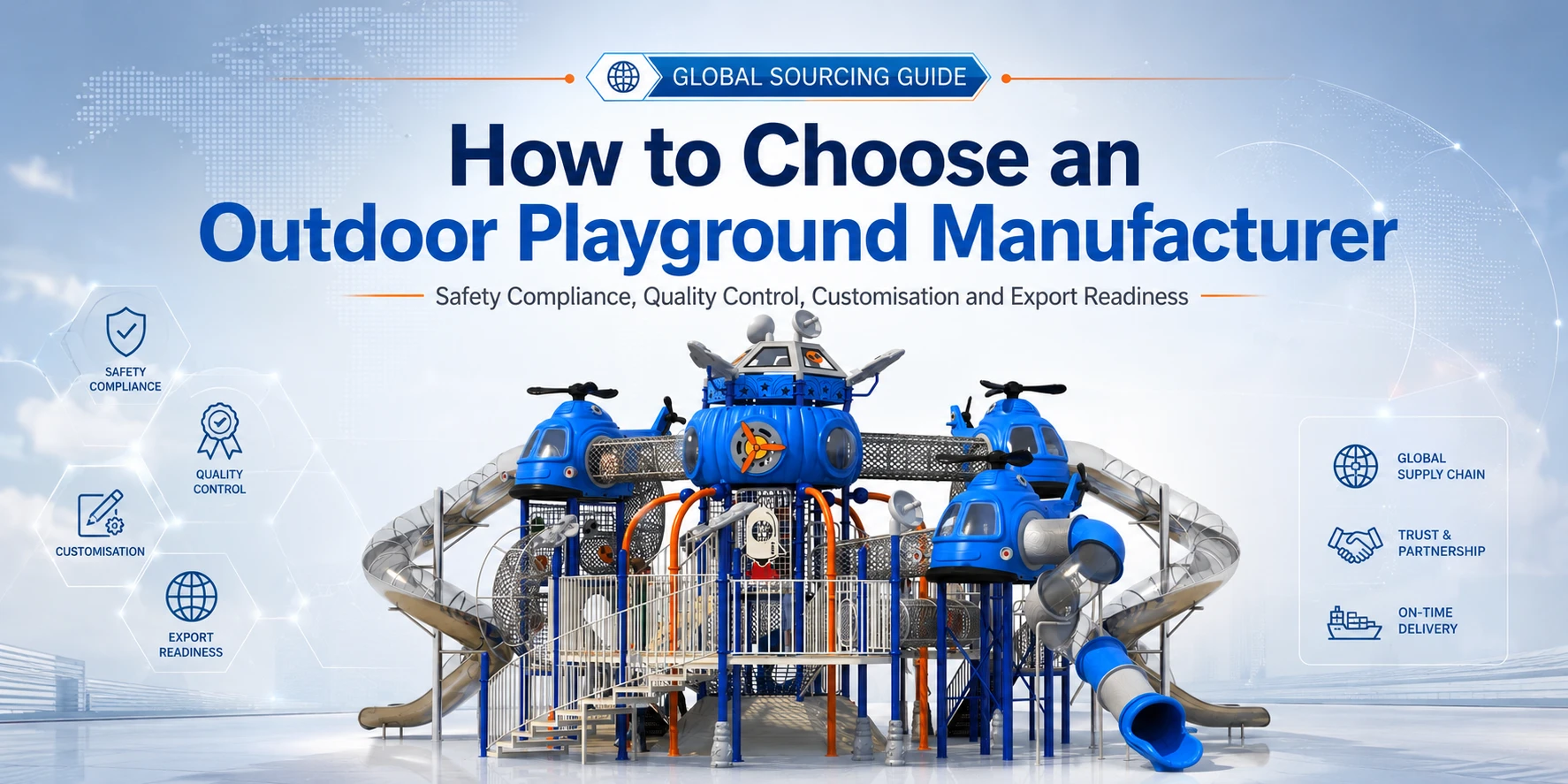
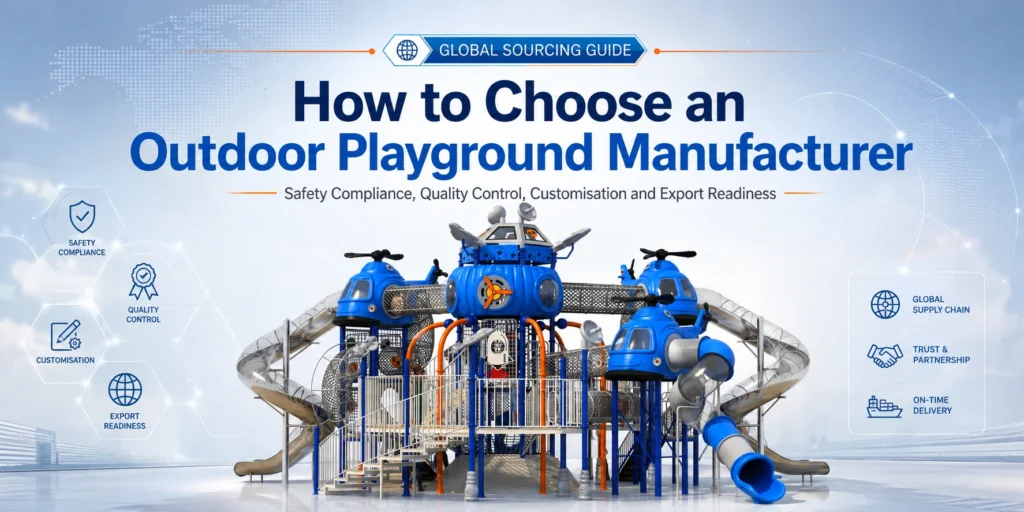
Sourcing a playground manufacturer from another continent carries real risk. You are not simply buying equipment; you are betting on safety compliance, quality control, customisation ability, and export readiness. Get any one wrong and your project stalls at customs or fails inspection.
An outdoor playground manufacturer is a factory or brand that designs, engineers, and produces commercial play equipment for parks, schools, and public spaces. Supplier differences matter more than the initial quote.
This guide gives a structured overview for global playground sourcing — comparing leading manufacturers, product categories, cost benchmarks, and evaluation criteria before you send your next RFQ.
Global Outdoor Playground Manufacturers: Brand Positioning and Product Focus
SERP-visible manufacturers split into full-line global brands and niche specialists. That distinction shapes your supplier mix.
Playworld positions around custom, themed play structures and inclusive design. GameTime claims one in five playgrounds and offers a broad catalogue from post-and-deck to freestanding net climbers. Landscape Structures targets school and community play, with a strong sensory and inclusive line. Burke builds classic metal-and-plastic structures known for durability and value. Little Tikes Commercial promotes urban nature and inclusive play for early childhood and public spaces. KOMPAN leads on high-design, research-backed structures such as the Supernova and water play ranges.
Pairing one full-line brand with a niche specialist — or working with a playground equipment export supplier carrying multiple lines — covers flagship projects and value-led tenders. The next section classifies equipment by age, style, and component type to support SKU-level sourcing decisions.
Playground Equipment by Age, Style, and Component Type
Build your shortlist by sorting equipment three ways: age, style, and component type. Most outdoor playground manufacturer catalogues follow the same logic.
By age group
– Toddler (2–5): low decks, compact slides, crawl tunnels and ground-level sensory play.
– School-age (5–12): taller towers, overhead loops and multi-level climbers.
– Inclusive and adult: wheelchair-accessible routes, upper-body equipment and outdoor fitness stations.
By style
– Traditional: timber posts, metal slides and classic belt swings.
– Modern: sculptural forms and bold colours, such as KOMPAN’s Supernova spinner.
– Nature-inspired and urban nature: log-effect beams, rope nets and planted shade canopies.
By component type
– Multi-play structures, freestanding climbers, slides, swings and shade structures form the core order.
– Sensory panels and water play are rising line items; Landscape Structures’ Aquatix range shows how splash panels turn a dry site into a water destination.
For playground equipment distributor sourcing, mix full-line ranges with component specialists to cover every RFQ. The next section maps these categories to parks, schools and inclusive projects.
Markets and Applications: Parks, Schools, Inclusive, and Custom Playgrounds
Public parks and recreation departments buy for longevity and low maintenance. They favour galvanised steel structures, vandal-resistant fixings, and accessibility that meets local disability standards. School buyers, by contrast, work to budget cycles and curriculum goals, demanding age-segregated zones with clear supervision lines. Early childhood centres need compact layouts, lower deck heights, and sensory panels for under-fives.
Inclusive environments now shape specification across every segment. Wheelchair-accessible ramps, transfer platforms, ground-level activity panels, and harness-support swings are becoming baseline tender requirements. Custom and theme playgrounds call for bespoke fabrication for resorts, retail destinations, and events, while urban nature playgrounds prefer timber, planting, and water play that suits dense city settings. For importers, mapping these segments against regional compliance regimes — and covering both OEM playground export lines and private label playground equipment — shows which niches justify dedicated inventory.
Playground Cost Benchmarks and Funding Programs for Project Planning
Typical installed costs for a standard school play structure run from US$25,000 to US$75,000; inclusive designs, shade structures, and poured rubber surfacing lift projects to US$100,000–US$250,000. Custom themed installations can exceed US$500,000. Every outdoor playground manufacturer prices these variables differently, so verify against project-specific quotes rather than published averages.
Factors that move the price:
- Equipment scale and number of play events
- Materials: galvanised steel, recycled plastic, or timber
- Safety surfacing: poured rubber versus engineered wood fibre
- Shade structures, fencing, and seating
- Inclusive features such as wheelchair-accessible decks and sensory panels
- Custom design, theming, and shipping distance
Funding is widely available through federal grant programmes — Community Development Block Grants, the Land and Water Conservation Fund, and USDA Community Facilities loans — plus state recreation grants and school capital budgets. Sharing a funding map alongside your cost ranges strengthens client bids and shortens decision cycles. With budgets framed, next comes evaluating supplier compliance and export readiness.
How to Evaluate an Outdoor Playground Manufacturer Before RFQ
Send an RFQ only after you have verified the factory against your compliance and logistics requirements. A low quote means little if the paperwork fails at customs.
- Safety certifications: Ask for current certificates for ASTM F1487, EN1176, or CSA Z614, matched to your target market. Confirm the test lab and whether the certificate covers the specific model, not just the factory.
- Factory audit signals: Check for documented welding and coating inspections, batch traceability, and a quality manual. A manufacturer that declines a video audit is a red flag.
- Customisation and OEM: Confirm they handle custom colours, logos, private-label packaging, and structural modifications before you commit volume.
- Export readiness: Request the playground equipment customs documents in advance — commercial invoice, packing list, and origin certificate — plus fumigation marks on timber parts for multi-country playground projects.
- Lead times and after-sales: Get lead times in writing and clarify spare-parts availability and warranty response procedures.
Treat missing compliance paperwork or no reference projects as immediate disqualifiers, not negotiable points.
About JQ Playground – globalplaygroundsource.com
JQ Playground (Wenzhou Jiqi Amusement Equipment Co., Ltd.) is a children’s playground equipment manufacturer founded in 1993. The company provides design, customization, large-scale manufacturing, sales, installation guidance, and after-sales support for outdoor playgrounds, indoor playgrounds, soft play, water playgrounds, PE board playgrounds, kindergarten furniture, outdoor fitness equipment, pet playgrounds, and playground facilities. Approved company facts include 180+ employees, a large Wenzhou production base, 20+ production lines, 55 production machines, ISO/BSCI/EN1176/EN71/ASTM/CPC/CPSIC certification references, 100+ patents, free design support, OEM/ODM capability, trial installation before shipping, export experience, and one-year quality warranty.