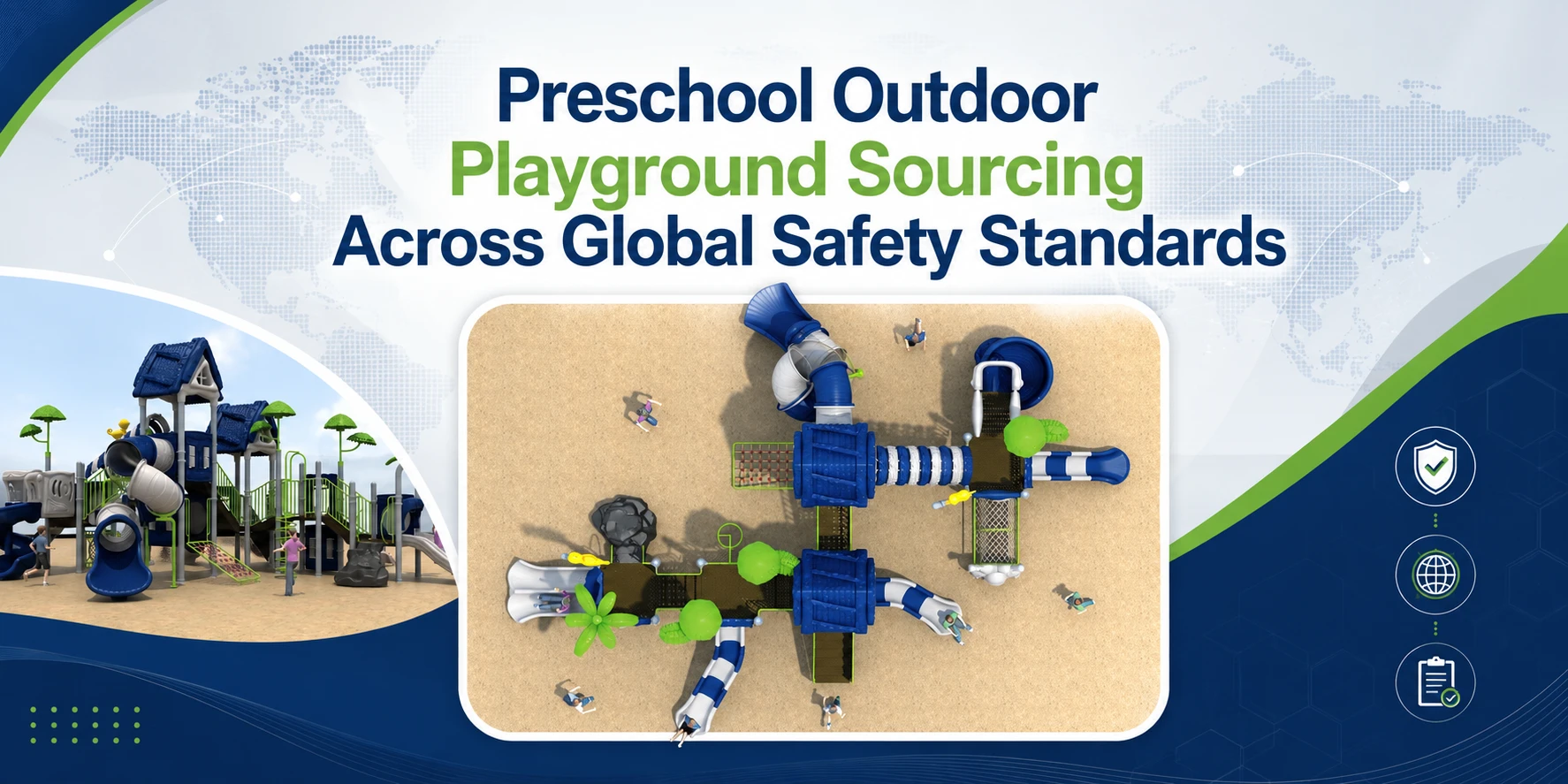
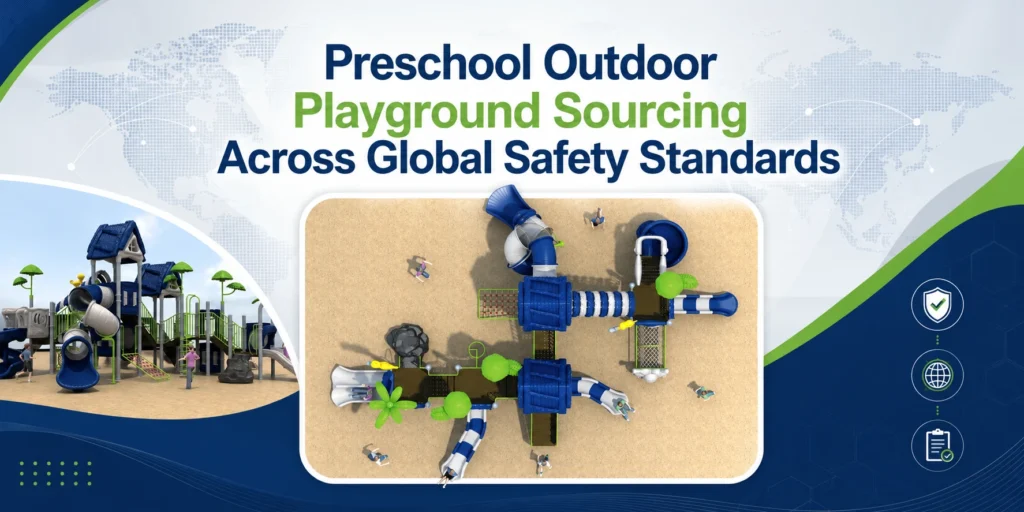
International buyers sourcing preschool playground equipment for multiple countries face a common challenge: balancing compliance with local safety standards while keeping costs competitive. One set of playgrounds must meet EN1176 in Europe, another ASTM F1487 in the USA, and a third AS 4685 in Australia. For buyers engaging in global playground sourcing, understanding these variations is the first step to successful procurement.
Preschool outdoor playground equipment refers to age-appropriate play structures for children aged 2–6, designed to develop motor skills and social interaction while meeting global safety regulations on fall height, entrapment prevention, and structural integrity.
This guide covers equipment categories, certifications, design strategies, and supplier evaluation to help you source compliant, cost-effective playgrounds across multiple markets.
Preschool Playground Equipment Categories for Global Procurement
Five equipment types dominate preschool playground procurement: slides, swings, climbers, sandboxes, and multi-play units. Each has specific age ranges, material options, and safety parameters that vary by region. When selecting an international playground supplier, matching these categories to local preferences reduces lead time and compliance risk.
Slides target children aged 2–5 with heights typically between 1.0 and 1.8 metres. Rotomolded plastic is common in hot climates (resists UV fading), while stainless steel suits cooler regions. Fall height must not exceed 1.5 metres for preschool models. In Europe, wave slides are popular; Middle Eastern buyers prefer straight slides with shade canopies.
Swings for ages 2–6 use bucket seats for younger children and flat belt seats for older ones. Key specs include seat height (350–450 mm) and clearance zone (minimum 1.5 m each side). Galvanised metal frames require less maintenance than timber, but wood is preferred in Nordic markets for natural aesthetics.
Climbers include arches, ladders, and nets. Maximum fall height is typically 1.2 m for this age group. Plastic climbers dominate in Asia-Pacific due to lighter shipping weight; wooden units are favoured in Australia for durability. A 2023 industry report noted that climbing nets now appear in 40% of European preschool tenders.
Sandboxes with lids reduce contamination. Capacities range from 0.5 to 2 cubic metres. Liner options (geotextile fabric) prevent weed growth. In the Middle East, sandboxes are often replaced with rubber play surfaces to minimise sand ingestion.
Multi-play units combine three or more activities. They account for 38% of preschool procurement volume in Asia-Pacific, according to the 2023 Global Playground Market Report. These structures require a minimum safety zone of 2 metres around all sides. Material choice often depends on shipping costs: plastic multi-play units are lighter and cheaper to freight, making them the default for many playground equipment export suppliers targeting price-sensitive markets. Manufacturers like JQ Playground offer a wide range of multi-play units with customizable themes and colors, supporting OEM and ODM requirements for global buyers.
By evaluating each category’s regional popularity and safety thresholds early, you can streamline requests for quotation and avoid costly redesigns.
Essential Safety Certifications for Preschool Playground Equipment in Key Markets
If you export playground equipment across borders, each market demands a specific certificate of compliance. Without the correct approval, customs can hold your shipment and insurers may refuse liability cover. Three standards dominate global procurement: ASTM F1487 (USA), EN 1176 (Europe), and AS 4685 (Australia).
| Standard | Region | Fall zones & surfacing | Entrapment prevention | Structural integrity |
|---|---|---|---|---|
| ASTM F1487 | USA | 6 ft critical fall height zones | Head, neck, clothing entrapment tests | Static load 4.5x max user weight |
| EN 1176 | Europe | Drop height up to 3 m based on surface | Probes for openings 5–15 mm | Test cycles up to 100,000 moves |
| AS 4685 | Australia | Similar to EN 1176 but with 1.5 m max free fall height for under-3s | Additional cord and loop entrapment checks | Galvanised steel verification |
For the Middle East, most countries reference either EN 1176 or adopt the Gulf Standardisation Organisation (GSO) framework, which aligns closely with EN 1176 but may require supplementary heat-resistance testing for plastics.
A compliant certificate is your proof of due diligence. Improper certification can lead to seizure at port, product recalls, and legal claims after an injury. Distributors and importers should request third-party test reports before signing a purchase order — it’s a small step that avoids months of rework. Reliable suppliers, such as JQ Playground, hold certifications including EN 1176, ASTM F1487, and other international standards, ensuring their equipment passes customs clearance in target markets.
Designing Multi-Market Playgrounds: Materials, Layout, and Cultural Preferences
A successful preschool playground for multiple markets starts with material selection that matches local conditions. One playground design does not fit every climate, user expectation, or accessibility law.
Materials
Rotomoulded polyethylene works well in hot, arid climates. It resists UV degradation and surface temperatures stay lower than metal. For Middle East projects, this plastic reduces heat absorption by up to 40% compared to steel options. Galvanised steel suits coastal areas where salt spray corrodes standard painted metal. A 2021 industry test showed hot-dip galvanised frames withstood 3,000 hours of salt spray exposure without red rust. Timber offers natural aesthetics preferred in Scandinavian and Japanese markets. It requires annual sealing in rainy regions, but children prefer the tactile warmth over plastic. For OEM playground export, material choice must match the buyer’s regional environment first, then budget.
Layout
Shading is critical in equatorial zones. A 50% UV-blocking canopy reduces surface temperatures by 8–12 °C, extending play time during midday. Surfacing demands fall-height compliance: rubber tiles up to 2 m fall height meet EN 1177 standards, whereas sand needs 300 mm depth for a 1.8 m fall. Rubber tiles cost more upfront but need less top-up maintenance. Accessibility following EN 17210 requires transfer platforms, ramp gradients under 1:12, and ground-level play activities. Private label playground equipment often specifies rubber surfacing as a standard to simplify certification across EU and North American projects.
Cultural Preferences
Themes vary dramatically. Castle structures lead in UK and French tenders, while nature-inspired treehouse designs dominate Australian and German specifications. Colour psychology influences choice: bright primary colours encourage active play in public parks; muted earth tones suit suburban settings where parents want visual integration. Local play traditions matter — in Japan, low-height balance beams and stepping stones are popular for group coordination. Past projects show that buyers who adapt at least two cultural elements (theme + colour) see 30% faster regulatory approval and higher user satisfaction.
Evaluating Suppliers for Preschool Playground Equipment: Quality, Compliance, and Logistics
A reliable supplier evaluation framework starts before you send an RFQ. You need to verify three areas: production capability, certification readiness, and shipping reliability.
Begin with a factory audit. Check whether the manufacturer uses rotomoulding machines for plastic parts and whether welds on metal frames meet ISO 3834 or equivalent standards. Request sample testing of a multi-play unit to confirm fall height, entrapment gaps, and material durability. Ask for certification documents upfront – EN 1176 test reports for Europe, ASTM F1487 for North America, or AS 4685 for Australia. Without these, customs clearance will stall.
Lead times vary by customisation level. Stock configurations ship in 25–35 days; bespoke colour or theme changes add 10–15 days. For export packaging, specify plywood crates with foam inserts to prevent scratches during 40‑day sea freight. Use FCL (full container load) for orders above 40 m³ to reduce per-unit cost; LCL (less than container load) works for smaller shipments but raises damage risk. Standard playground Incoterms are FOB (factory responsibility until loading) or CIF (seller covers freight and insurance). Payment terms typically require 30% deposit, 70% before shipment or against bill of lading.
Mitigate risk with a third-party pre-shipment inspection – check welds, plastic thickness, and colour consistency. Use this checklist when evaluating supplier responses to your RFQ:
- Factory audit report within 12 months (ISO 9001 preferred)
- Sample test results matching your target standard (EN 1176, ASTM F1487, or AS 4685)
- Certification documents in English and buyer’s local language
- Confirmed lead time with liquidated damages clause
- Customisation capability: colour, theme, logo, and safety surfacing type
- Playground shipping and packing method: plywood crate type, internal bracing, moisture barrier
- Incoterms offered (FOB or CIF) and port of loading
- Payment terms: 30/70 TT or L/C at sight
- Third-party inspection company name and scope (e.g. SGS, Bureau Veritas)
As a practical example, JQ Playground operates a 60,000 sqm production base with 20+ production lines and 180+ skilled workers. The company offers free CAD design services, trial installation before shipping, and a one-year warranty. With 8 QC checkpoints and 100+ patents, JQ Playground exemplifies the production capability and compliance readiness that importers seek in a playground equipment export supplier. Their experience in handling 2,000+ containers annually ensures reliable logistics for global playground sourcing projects.
About JQ Playground – globalplaygroundsource.com
JQ Playground (Wenzhou Jiqi Amusement Equipment Co., Ltd.) is a children’s playground equipment manufacturer founded in 1993. The company provides design, customization, large-scale manufacturing, sales, installation guidance, and after-sales support for outdoor playgrounds, indoor playgrounds, soft play, water playgrounds, PE board playgrounds, kindergarten furniture, outdoor fitness equipment, pet playgrounds, and playground facilities. Approved company facts include 180+ employees, a large Wenzhou production base, 20+ production lines, 55 production machines, ISO/BSCI/EN1176/EN71/ASTM/CPC/CPSIC certification references, 100+ patents, free design support, OEM/ODM capability, trial installation before shipping, export experience, and one-year quality warranty.