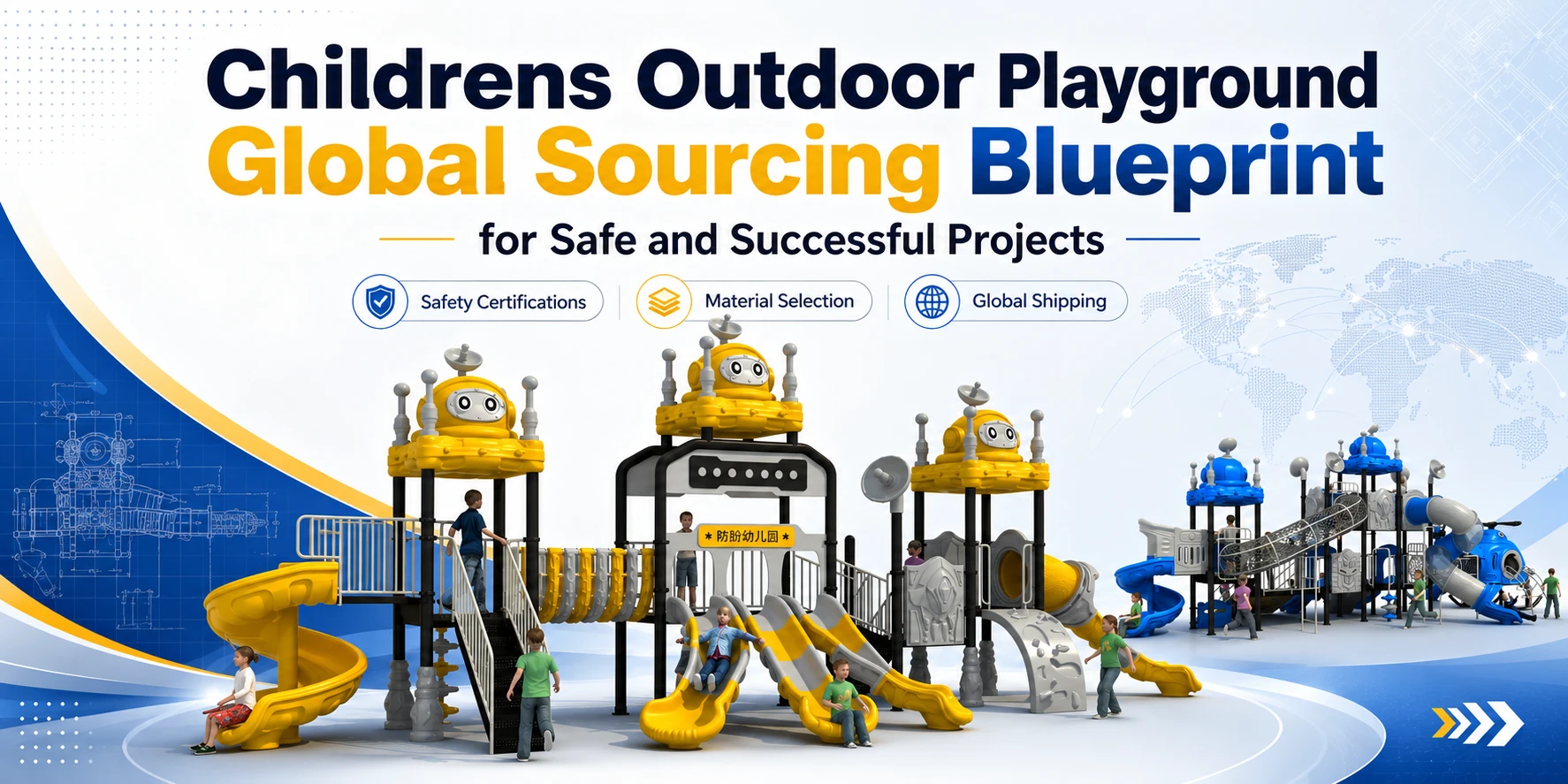
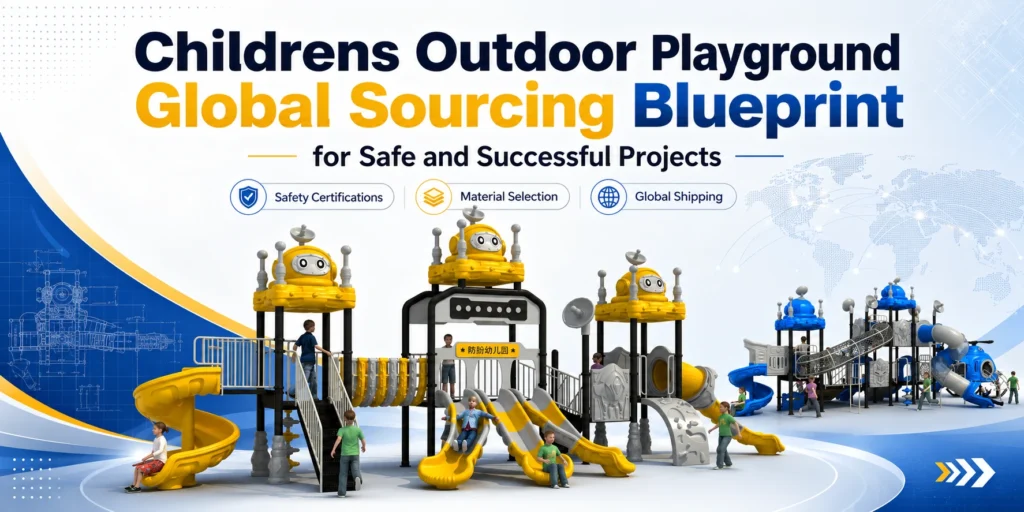
For childrens outdoor playground, buyers need guidance that matches the exact query intent before comparing suppliers, specifications, or RFQ details.
Global buyers sourcing children’s outdoor playground equipment encounter fragmented supplier markets, inconsistent safety regulations from country to country, and logistics hurdles that delay project timelines. For global playground sourcing to succeed, you need clear product specifications and verified compliance documentation. Without these, cross-border procurement risks inflated costs, customs delays, and non-compliance penalties that could shut down an installation.
Children’s outdoor playground equipment covers commercial-grade swings, slides, climbers, sensory panels, and multi-play structures designed for public parks, schoolyards, and residential complexes. These products use materials rated for heavy daily use — typically UV-resistant polyethylene, galvanised steel, or powder-coated aluminium — and must meet specific safety and durability benchmarks for each target market.
This guide covers equipment categories, material selection, required safety certifications, export logistics, and supplier evaluation methods for multi-country procurement projects.
Types of Commercial Children’s Outdoor Playground Equipment and Material Choices
Choosing the right equipment and materials directly impacts your project’s lifespan, maintenance schedule, and safety compliance. Commercial-grade playgrounds typically last 10–15 years with proper care, so the decisions you make at procurement stage matter.
Key Equipment Categories
- Swings – Belt seats for ages 2–5 vs. bucket seats for toddlers. Rubber-coated chains reduce pinch points and noise. In high-traffic parks, install reinforced hanging brackets rated for 150 kg per bay.
- Slides – Straight, wave, or spiral designs. Commercial slides must have a minimum exit zone of 300 mm and a maximum fall height of 1.5 m for ages 3–5, 2.0 m for ages 6–12 (per EN 1176). Stainless steel beds resist fading but can heat up in direct sun; rotationally moulded polyethylene (PE) stays cooler.
- Climbing Structures – Net climbers, arch climbers, and rock walls. Node connectors on nets should have UV-stabilised nylon. Static rope cores (polyester over polypropylene) provide better grip and less stretch than polypropylene-only options.
- Sensory Panels – Braille wheels, xylophones, and tactile mazes fitted to existing structures. Panels need sealed edges and captive hardware to prevent vandalism. Typical lifespan: 5–8 years due to constant handling.
- Multi-Play Units – Combine slides, climbers, tunnels, and platforms. Modular steel posts with powder-coated finish allow future expansion. Ensure platforms are at least 1 m above ground with guardrails 700 mm high for ages 3–5.
Material Selection by Climate
Hot, sun-exposed regions (Middle East, Australia) demand UV-resistant PE with an anti-static additive to reduce heat absorption. Galvanised and powder-coated steel works well in humid coastal areas where rust is the primary risk. Aluminium suits salt-spray zones but costs 20–30% more. Wood composites, while aesthetic, require annual sealant coats and are not recommended for wet climates unless the core is encapsulated in a high-density polyethylene shell.
If you are cross-referencing material specs with an international playground supplier, always ask for the UV-stability test report (ASTM D2565) and salt-spray resistance hours (ASTM B117). The same advice applies when evaluating any playground equipment export supplier – material performance data should match your local climate conditions.
Global Safety Certifications You Must Verify for Cross-Border Projects
If you are sourcing playground equipment for multiple countries, verifying safety certifications is not optional — it is a compliance requirement that directly affects customs clearance and liability exposure. Four standards dominate global procurement: ASTM F1487 (USA), EN1176 (Europe), CSA Z614 (Canada), and AS 4685 (Australia). Each differs in fall height limits, spacing requirements, and material testing protocols.
| Standard | Region | Key Requirements |
|---|---|---|
| ASTM F1487 | USA | Fall height ≤ 3.0 m for most equipment; 18-inch guardrail spacing; impact attenuation testing per ASTM F1292 |
| EN1176 | Europe | Fall height varies by equipment type (e.g., ≤ 3.0 m for swings, ≤ 2.5 m for slides); 120 mm spacing for entrapment; structural testing using European norms |
| CSA Z614 | Canada | Similar to ASTM but with additional anchoring requirements for wind and frost; colour-coded danger zones for overhead equipment |
| AS 4685 | Australia | Fall height ≤ 2.5 m for most equipment; 100 mm maximum spacing; UV exposure testing mandatory for components in direct sun |
Missing the correct certification can result in customs holds, fines, or site rejections. For example, a slide that meets ASTM F1487 fall height limits may exceed the EN1176 limit for the same structure, causing a safety audit failure. Always request a copy of the supplier’s current certification certificate, not just a marketing claim. Cross-check the certificate number against the issuing body’s online database. Specify your target country in the RFQ so the supplier provides the correct standard — this is critical for any playground equipment importer guide or playground equipment distributor sourcing workflow involving multiple jurisdictions.
Export Logistics and Shipping Considerations for International Buyers
Once safety certification is confirmed, the next critical layer is your shipping strategy. FOB (Free on Board) and CIF (Cost, Insurance, Freight) are the two most common Incoterms for playground equipment. With FOB, you control the freight; with CIF, the supplier arranges shipping to your destination port. For large private label playground equipment orders, CIF often simplifies coordination, but FOB gives you flexibility to choose your own forwarder.
Container selection affects cost and packing density. A 20GP container holds roughly 28 CBM and suits smaller playground components. A 40HQ container (76 CBM) is standard for multi-play structures and slide sets. Typical lead times from order to shipment run 30–60 days, depending on customisation and production scheduling.
Packaging must withstand ocean freight. Suppliers should wrap each part in shrink wrap, fit corner protectors on sharp edges, and use plywood crates for heavy platforms. Inadequate packaging leads to freight claims.
Shipping process in five steps
- Confirm Incoterms and delivery port. Choose FOB (factory gate risk transfer) or CIF (supplier handles shipping). Common destination ports include Los Angeles (US West Coast), Hamburg (Europe), and Jebel Ali (Middle East). Verify your country’s import duties — for example, playground equipment entering the US under HS 9506 often attracts 0–4.9% duty, while EU rates vary by material classification.
- Book container and schedule loading. Notify the supplier of your preferred container size (20GP or 40HQ). They will crate and load the equipment, taking photos for your inspection.
- Prepare export documentation. The supplier must provide a commercial invoice, packing list, bill of lading, certificate of origin, and safety certificates (ASTM, EN1176, etc.). For OEM playground export orders, include your brand details on the packing materials to avoid customs confusion.
- Ship to port and clear export customs. The freight forwarder handles export clearance in the origin country. Transit time from, say, Ningbo to Los Angeles is typically 18–22 days.
- Import clearance and delivery. Provide your customs broker with all documents at least 48 hours before vessel arrival. Any missing safety certificate can cause delays and storage fees.
Double-check your local tariff code before finalising the order — a misclassification can double your duty cost.
How to Shortlist Suppliers for Multi-Country Playground Projects
When managing playground projects across multiple countries, your supplier shortlist hinges on a structured request for quotation (RFQ). Start each RFQ by asking for product catalogues, detailed material specifications, copies of relevant safety certifications, and at least two reference projects from regions similar to yours.
Evaluate MOQ flexibility early — some suppliers require 50+ units for custom colours, while others accept 10-unit minimums for standard models. Check OEM and private-label capabilities if you plan to brand the equipment for local distributors. After-sales support matters just as much: spare parts availability, warranty claim procedures, and technical documentation for on-site assembly.
Use this checklist when reviewing supplier responses:
- Product catalogues with material thicknesses (e.g., 15mm PE board, 2.0mm galvanised steel)
- Certification copies (ASTM F1487, EN1176, CSA Z614) — verify against your target country
- Reference projects in similar climates or with comparable logistics complexity
- MOQ and OEM/private-label terms
- After-sales support: stock of spare parts, warranty period, response time
- Sample inspection availability or third-party testing reports (colour fastness, UV resistance, load tests)
- Client references, especially from buyers in your region
- Preferred Incoterms (FOB vs CIF) and packing standards — this links directly to playground shipping and packing requirements
- Typical lead time and shipping port options
Red flags to watch for: no physical factory address or only a virtual office, vague warranty language (“limited” without defined terms), refusal to share full certification documents, or a year-old certificate that may no longer be valid. A supplier who cannot provide client references from your region likely lacks export experience. If they dodge your sample inspection request, move on.
About JQ Playground – globalplaygroundsource.com
JQ Playground (Wenzhou Jiqi Amusement Equipment Co., Ltd.) is a children’s playground equipment manufacturer founded in 1993. The company provides design, customization, large-scale manufacturing, sales, installation guidance, and after-sales support for outdoor playgrounds, indoor playgrounds, soft play, water playgrounds, PE board playgrounds, kindergarten furniture, outdoor fitness equipment, pet playgrounds, and playground facilities. Approved company facts include 180+ employees, a large Wenzhou production base, 20+ production lines, 55 production machines, ISO/BSCI/EN1176/EN71/ASTM/CPC/CPSIC certification references, 100+ patents, free design support, OEM/ODM capability, trial installation before shipping, export experience, and one-year quality warranty.