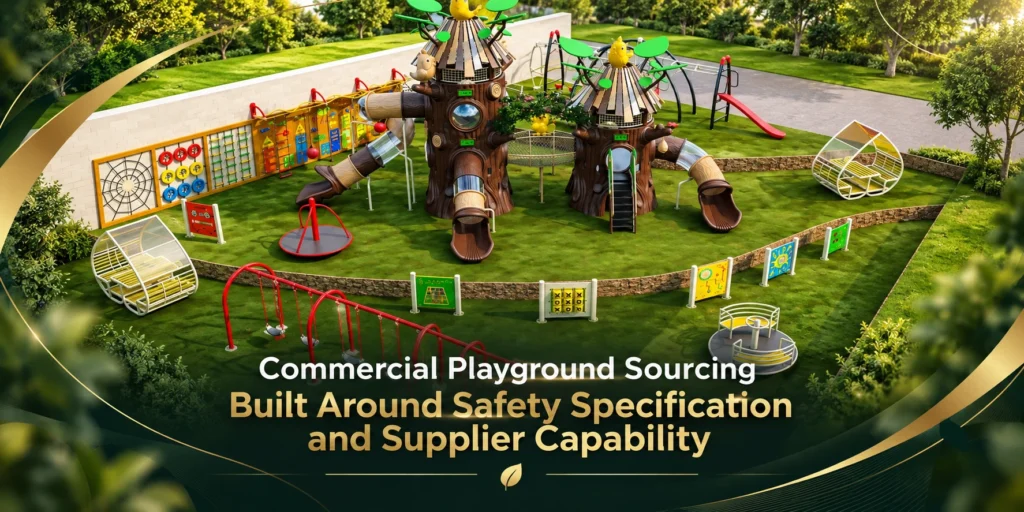
Global playground sourcing rarely fails on price alone. It fails on specification: age group, safety standard, site footprint, installation method. Buyers who confirm those four points before requesting quotes avoid redesigns, delayed shipments and tender rejections later.
A commercial playground is a permanent play installation built for public or institutional use, made from steel, aluminium, timber or HDPE components, and rated for defined age groups. It combines climbing frames, slides, swing sets and impact-absorbing surfacing, and must satisfy the safety standard of the country where it is installed.
The sections below explain how these structures work, what buyers specify, and how custom production runs.
How Commercial Playground Works
A commercial playground converts a fixed footprint into a sequenced play route rather than a collection of standalone units. Buyers verify four steps before ordering.
- Plan the footprint – Map decks, posts and surfacing against age band and intended user capacity.
- Anchor and assemble – Post bases are cast into concrete footings or bolted to surface plates, then decks, slides and climbers fix in sequence.
- Check clearances – Confirm fall heights, impact-absorbing surfacing depth and entrapment gaps against the standard your market enforces.
- Record and repeat – Log part numbers, colours and finishes so replacement parts and later batches match the first run.
What each component does
Posts carry structural load, decks set levels, and slides, swings or climbing panels deliver play value. Clamps and fasteners hold the tolerances your safety checks actually measure.
For a playground equipment export supplier, the real sourcing test is repeatability: identical drawings, hardware and finish batch after batch.
Commercial Playground Components and Product Types
Five product families cover most commercial playground orders, and each carries a different spec sheet for a playground equipment importer guide.
| Product type | What it covers | Confirm before RFQ |
|---|---|---|
| Modular structure | Posts, decks, roofs, slides | Post diameter, deck height band |
| Swing set | Frames, chains, seats | Bay spacing, seat load per bay |
| Climbing unit | Nets, holds, panels | Fall height, rope diameter |
| Surfacing and hardware | Wet-pour, tiles, bolts, clamps | Critical fall height, fixing finish |
- Post sizes move in 89 mm and 114 mm steps; deck heights of 1.0–2.4 m change guardrail and fall-height requirements.
- Ask for seat, bearing and clamp spare lists with the quote — standard practice in playground equipment distributor sourcing.
Swing sets and climbing units are quoted separately from modular structures, so check fixings and load ratings line by line rather than as one package. Which type suits your site follows from the application.
Typical Applications for Commercial Playground
Application decides specification faster than any catalogue page.
- Schools and nurseries: low-deck modular units for ages 3–5, often 10–30 per order; ask for EN 1176 or ASTM F1487 reports and fall-height data.
- Municipal parks: multi-age steel-post structures; check galvanised coating thickness and post-weld inspection records.
- Hospitality and retail: compact themed units in brand colours — the usual route to private label playground equipment; request colour panels and logo proofs.
- Resorts and contractors: OEM playground export orders where swing hanger connectors, deck clamps and bolt grades must suit local ground conditions; confirm torque values and hardware lists.
| Factor | Buyer action |
|---|---|
| Age band | Match deck height, rail spacing and slide length |
| Climate | Confirm galvanising plus UV-stable powder coat |
| Batch size | Agree a sampling plan per shipment |
With the application fixed, the next decision is the manufacturing route: drawings, samples, packaging and inspection.
Custom Commercial Playground Manufacturing and OEM Cooperation
Custom work runs on six fixed stages. Send dimensioned drawings (DWG or PDF), a site plan, or a physical sample, and expect a marked-up drawing set before a firm price. That order matters on any commercial playground project where colourways, logo plates, and fixings differ from stock.
| Stage | Buyer input | Manufacturer output |
|---|---|---|
| 1. Drawings or sample | Dimensioned drawing, site plan, or sample part; target quantity | Feasibility note, material list, marked-up drawing |
| 2. Quote | Finish, colour, logo, packing preference, Incoterms (FOB, CIF, DDP) | Unit price, tooling cost, lead time, Incoterms options |
| 3. Sample confirmation | Written sign-off on colour, hardware, nameplate | Pre-production sample with test readings |
| 4. Packaging | Carton marks, pallet or container preference | Packing plan covering playground shipping and packing |
| 5. Batch inspection | AQL level or full-check list | Report with photos, torque and coating-thickness values |
| 6. Shipment | Booking window, document list | Container load plan, bill of lading, origin papers |
What Sample and Batch Checks Should Prove
A pre-production sample should be load-tested and photographed against your drawing. Batch inspection then repeats those same readings on later containers, not only the first. With the route proven, shortlisting turns on capacity and category fit.
Top 10 Commercial Playground Manufacturers and Supplier Fit
Shortlisting starts with your buying model, not a brand list. The five supplier types below cover most tender routes, from spec-led council work to private-label batches.
| Supplier type | Pros | Cons | Best fit |
|---|---|---|---|
| European modular system makers | Published per-item EN 1176 test evidence | Lead times measured in months, not weeks | Tenders where certification documents are scored |
| US turnkey design-build integrators | One quote covering design, install and surfacing | Region-bound; costly to export | Single-country projects with a fixed handover date |
| Asian custom OEM fabricators | Custom dimensions, colours and packaging; sample support | You fund and run your own inspection | Private-label ranges and multi country playground projects |
| Regional steel fabricators | Short haulage; fast local repairs | Narrow play-value range; limited test data | Small school or park refits |
| Distributor stockists | Spare parts in days, small order volumes | Mixed brands; added margin per unit | Top-up orders and replacement parts |
Scoring checklist:
- Certification: request per-item test reports, not per-range statements.
- Capacity: ask for monthly output plus two recent shipment references at your volume.
- Sample gap: compare sample lead time against production lead time before committing.
- Logistics: confirm container fill rate, sea-freight corrosion protection, and playground equipment customs documents before booking.
- After-sales: confirm three-year spare part availability and a named technical contact.
Score suppliers on evidence you can audit — per-item test reports, container photos, spare-part lists — not catalogue imagery.
About JQ Playground – globalplaygroundsource.com
JQ Playground (Wenzhou Jiqi Amusement Equipment Co., Ltd.) is a children’s playground equipment manufacturer founded in 1993. The company provides design, customization, large-scale manufacturing, sales, installation guidance, and after-sales support for outdoor playgrounds, indoor playgrounds, soft play, water playgrounds, PE board playgrounds, kindergarten furniture, outdoor fitness equipment, pet playgrounds, and playground facilities. Approved company facts include 180+ employees, a large Wenzhou production base, 20+ production lines, 55 production machines, ISO/BSCI/EN1176/EN71/ASTM/CPC/CPSIC certification references, 100+ patents, free design support, OEM/ODM capability, trial installation before shipping, export experience, and one-year quality warranty.