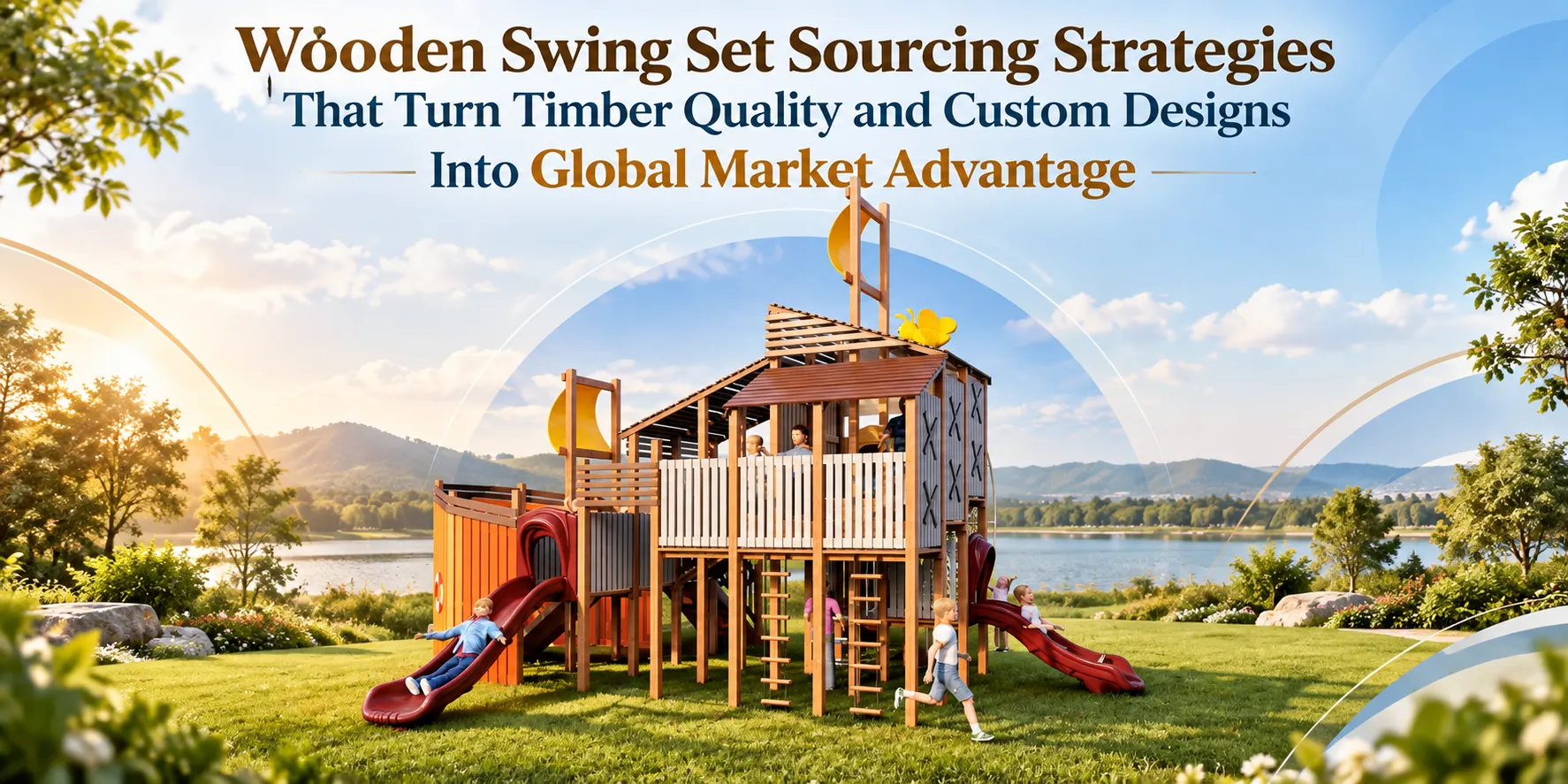
Sourcing a wooden swing set for a distributor range is not a price-only decision. Species, deck configuration, and delivery windows decide whether a container lands sellable — and RFQs stall when those details stay vague.
A wooden swing set is a timber-framed playset combining a support beam, swing hangers, and one or more deck-and-slide modules, supplied either as a fixed kit or as a configurable assortment for import and resale.
The sections below break down how supplier catalogue signals, materials, and cost bands shape a global playground sourcing plan for importers.
Wooden Swing Set Supplier Brand, Material, and Origin Signals for Importer Benchmarking
Category pages rarely describe factories; they describe ranges. Use those patterns to rank an international playground supplier before you request quotes.
- Range depth. Count how many wooden swing set models sit under one branded collection. Four to eight SKUs suggests in-house design; two scattered models often points to trading-office sourcing.
- Species naming. Cedar, pine, and factory-finished timbers are stated outright. “Solid wood” alone leaves species, moisture content, and staining undefined.
- Customisation options. Colour, roof, slide, and platform choices listed on a category page show how far a wooden swing set line can flex for private-label programmes.
- Origin cues. Port references, shipping terms, or “made in” wording indicate export experience rather than domestic-only supply.
Read the signals together. One strong indicator proves little; three consistent ones justify a sample request and a line-sheet review.
Wooden Swing Set Configurations Across Supplier Catalogs: Decks, Slides, Climbing Walls, and Forts
Five component families repeat across nearly every wooden swing set catalog: decks and towers, swing beams, slides, climbing walls, and accessory bundles. Base models pair one deck with two swing positions. Mid-tier sets add a slide. Combination units stack a fort, climbing wall, and sandbox onto the same footprint.
Use this checklist to build line sheets for playground equipment distributor sourcing:
- Deck or tower — platform height, square or rectangular footprint, roof style
- Swing beam — single, A-frame, or triple-bay; beam length and leg spacing
- Slides — straight, wave, spiral, or tube; deck-to-ground drop
- Climbing walls and forts — rock-hold panel, rope net, lookout platform
- Accessory bundles — trapeze bar, glider, monkey bars, ground anchors
Assortment planning works best when tier names stay fixed across markets and only component counts move, so SKU mapping stays clean for importers and private-label buyers. Component naming is consistent; the wood behind it is not.
Cedar, Southern Yellow Pine, and Factory-Finished Wood: Material Grades for Cross-Border Sourcing
Species choice drives freight weight, movement inside humid containers, and how much finishing your distributor must absorb. The three options below behave differently once they leave the yard.
| Wood option | Moisture and movement | Staining and treatment | Climate fit |
|---|---|---|---|
| Western red cedar | Kiln-dried, low shrinkage, stable in transit | Takes stain evenly; often shipped unfinished or lightly sealed | Humid and coastal markets, lighter loads |
| Southern Yellow Pine | Denser, stronger; moves more if shipped above 15% MC | Pressure-treated for ground contact, then stained | Drier, high-UV markets; heavier bundles |
| Factory-finished wood | Sealed after drying, so moisture stays steady | Primer plus topcoat applied before packing | Buyers wanting minimal on-site labour |
Factory finishing shifts cost and risk downstream. Sealed panels arrive stable, cut site labour, and reduce the blotchy staining that raw cedar and pine can show after weeks in transit. Confirm that cut ends and drilled holes are re-sealed, since exposed grain absorbs water first and greys within a season. On OEM playground export orders, lock colour and sheen per market and name the species sitting under the coating.
Wooden Swing Set Cost Bands and Price Drivers for Wholesale Buying Programs
Landed cost on a wooden swing set tracks four levers before freight: footprint, component count, wood grade, and finish. Retail bands below reflect published category pricing; wholesale FOB sits lower and spreads wider as carton volume grows.
- Footprint and beam span — a 2.4 m single-beam frame uses far less timber than a 3.6 m multi-bay set.
- Design complexity — towers, angled roofs, and enclosed forts add cutting, joinery, and hardware steps.
- Feature count — every slide, climbing wall, or monkey-bar run adds a bought-in part and carton space.
- Wood grade and finishing — cedar and factory-finished stock cost more per board than untreated pine, and a factory coating adds a spray and drying pass.
- Packaging and volume — carton count, pallet density, and playground shipping and packing choices shift unit freight. Confirm playground Incoterms before comparing quotes.
| Band | Indicative retail | Typical configuration | Main cost lever |
|---|---|---|---|
| Entry | US$150–400 | 2 swings, single beam, A-frame | Beam length, board grade |
| Mid | US$400–900 | 2 swings, slide, climbing wall | Component count |
| Upper | US$900–2,000 | Tower, fort, roof, multi-bay beam | Timber volume, joinery |
| Premium | US$2,000–3,500 | Multi-deck, accessory bundles | Finish, carton complexity |
Two sets with the same footprint can differ 30–40% once slide, wall, and roof are specified.
Custom and Private-Label Wooden Swing Set Programs: Delivery, Installation, and Project Logistics
Documentation and delivery sequence decide whether a custom wooden swing set program opens on schedule. Four elements carry most of the risk.
- Design customisation. Lock deck size, slide type, roof profile, beam span, and stain shade before tooling. Colour and logo changes touch packaging artwork only.
- Customs paperwork. For playground equipment customs documents, align part numbers across packing list and invoice, declare wood species, and mark timber pallets as heat-treated or fumigated.
- Delivery and installation. Split container loading by port when multi country playground projects need staged opening dates; number hardware bags and supply manuals in the destination language.
- Spares. Hold replacement beams, brackets, and swing hangers sized to the rollout.
Agree each point in writing before the first production run.
About JQ Playground – globalplaygroundsource.com
JQ Playground (Wenzhou Jiqi Amusement Equipment Co., Ltd.) is a children’s playground equipment manufacturer founded in 1993. The company provides design, customization, large-scale manufacturing, sales, installation guidance, and after-sales support for outdoor playgrounds, indoor playgrounds, soft play, water playgrounds, PE board playgrounds, kindergarten furniture, outdoor fitness equipment, pet playgrounds, and playground facilities. Approved company facts include 180+ employees, a large Wenzhou production base, 20+ production lines, 55 production machines, ISO/BSCI/EN1176/EN71/ASTM/CPC/CPSIC certification references, 100+ patents, free design support, OEM/ODM capability, trial installation before shipping, export experience, and one-year quality warranty.