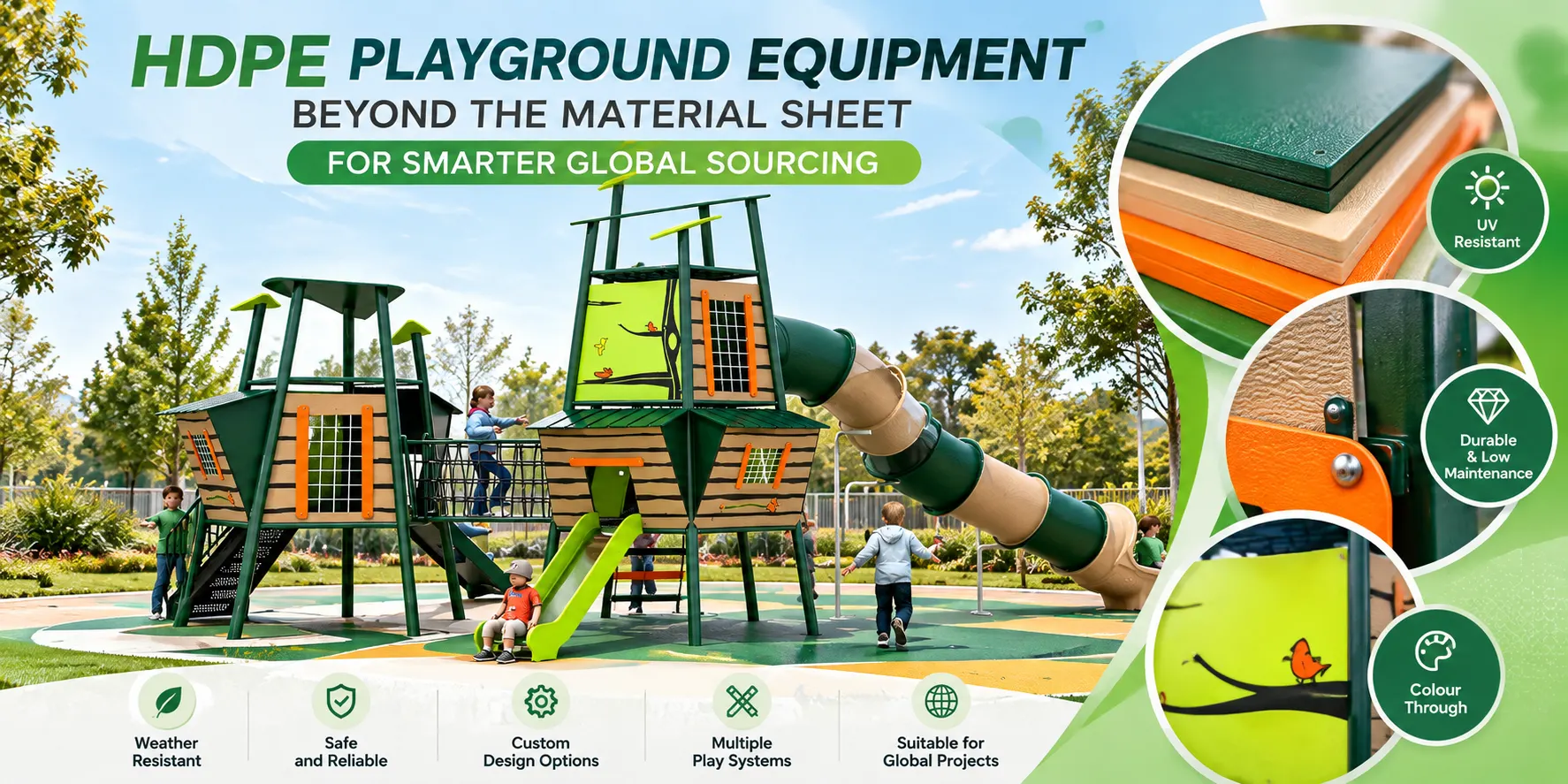
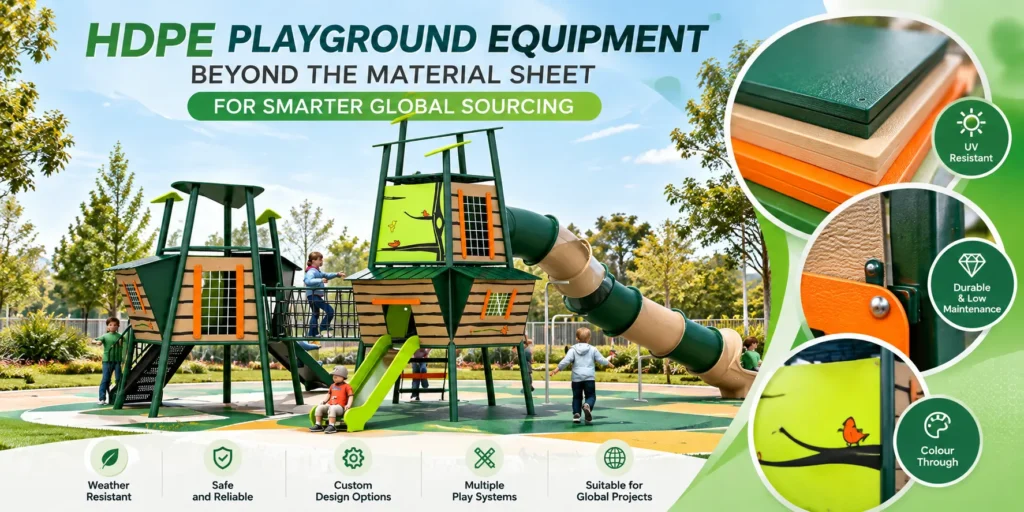
You are a distributor or project contractor comparing playground supply across several countries, and you need to decide whether HDPE belongs in the specification. HDPE playground equipment covers play structures, panels, decks, roofs and swing components fabricated from high-density polyethylene sheet or moulded profiles. That choice affects part replacement, colour matching and container loading.
This guide covers product categories, sheet specifications, weathering performance, custom quoting and export documentation for global playground sourcing.
HDPE Playground Equipment Categories: Structures, Play Panels, and Swing Sets
Catalogue ranges typically split into four groups.
- In-stock commercial play structures. HDPE covers decks, roofs and cladding, while posts and frames remain powder-coated steel or aluminium; plan for replacement-part requests on deck and roof panels.
- Standalone HDPE play panels and activity boards. The panel is HDPE sheet, but frames and fixings are usually aluminium or steel; colour matching across production batches is a key check.
- Industrial or heavy-duty playsets. HDPE appears on wear panels and roofs, with timber or steel carrying structural loads; flat-pack density is lower than all-panel orders.
- Retail-grade HDPE swing sets. Seats and moulded parts are HDPE, frames powder-coated steel; spare seat sets are the common follow-on order.
Container loading follows category mix. Flat panels nest densely, while built structures cube out on volume before weight limits are reached — so order splits change freight cost per unit. A playground equipment export supplier can confirm load plans.
Reading an HDPE Playboard Spec Sheet: Grades, Thickness, and UV Stability
A playboard sheet is sold as a semi-finished panel, not as play equipment. Plastics distributors list it by thickness, finish and colour; fabricators then cut, rout and bolt it into a finished panel. That gap matters for playground equipment distributor sourcing: the equipment catalogue shows a colour photo, while the sheet data sheet shows the grade, UV package and tolerance behind it.
| Sheet format | Thickness | Finish | Colourfast expectation | Typical playground use |
|---|---|---|---|---|
| Standard panel sheet | 12–15 mm | Smooth or one-side texture | Colour-through, often quoted at 2,000+ hours xenon-arc | Activity boards, infill panels, signage |
| Structural deck sheet | 18–25 mm | Double-sided texture | Colour-through with HALS package | Decks, roofs, climbing surfaces |
Put these questions to a supplier before you specify:
- Which resin grade and melt index?
- Colour-through or capped, and to what depth?
- UV stabiliser type and percentage loading?
- Quoted weathering hours and permitted colour shift (Delta E)?
- Sheet thickness tolerance and flatness figure?
Verifying Recycled and UV-Stabilised HDPE Claims Before You Specify
Eco criteria are scored in many multi-country tenders, so treat recycled-content wording as a claim to audit rather than a feature. Most recycled-HDPE statements cover decks, roof panels and play panels only; posts, fasteners and brackets are usually powder-coated steel or aluminium and carry none of that content. Watch for “recyclable” being read as “recycled” — they are different claims, and end-of-life take-back is rarely documented.
Request, and file, the following:
- Recycled-content percentage statement, split into post-consumer and post-industrial feedstock and tied to a part number.
- UV weathering test summary: exposure hours, test standard and retained impact strength.
- Colourfast results quoted as Delta E after a stated exposure period.
- Material safety data per sheet grade, plus confirmation that pigments and stabilisers meet the destination market’s limits.
Ask for the same pack on private label playground equipment and OEM playground export orders; catalogue documents rarely match the final configuration.
Custom HDPE Playground Builds: From Site Plan to Quotation
Custom work starts with a drawing, not a catalogue page. A buyer sends site dimensions, an existing layout file, or a theme brief; the supplier returns a proposed layout with a component mix — decks, panels, roofs, slides, climbers — sized to the space. Catalogue or in-stock ordering suits distributors refilling standard SKUs: you pick a model number and quantity, and little else changes. Site-fit builds trade that speed for a structure shaped around the plot.
A typical sequence runs as follows.
- Brief intake. You supply dimensions, photographs, or CAD drawings. A hand sketch with measured boundaries is enough to begin.
- Layout proposal. The supplier drafts one or more footprints, marking fall-height zones and safety surfacing areas around each structure.
- Component mix. Panel types, deck heights, roof styles and post spacing are adjusted to the age group and capacity target.
- Buyer revision. You change colours, panel graphics and structure size, usually over one or two rounds.
- Bill of materials. Every part is listed with dimensions, quantity and material, so packing volume can be estimated before pricing.
- Quotation. Unit price, packing configuration, lead time and freight terms follow the confirmed BOM.
Information that shortens the cycle:
- Scaled site plans, including boundaries, slopes and buried services.
- Fall-height and safety-zone requirements, with the target standard named.
- Age band and expected user count per session.
- Destination country standard, so the layout is drawn to the right rule set from the start.
- Colour references, given as codes rather than names.
Expect four to six weeks from first drawing to signed quotation on a multi-structure project. Incomplete briefs stretch that, because the supplier guesses at safety zones and revises later.
Sourcing HDPE Playground Equipment Across Multiple Countries: OEM, Packing, and Compliance Documents
Private-label HDPE playground equipment usually turns on colour matching and badge placement; moulded parts such as swing seats need tooling agreed before the order. Pack by part family — nest panels flat, crate steel hardware separately — and expect HDPE at roughly 950 kg/m³ to push a 40 ft container toward its payload limit before it is cube-full. Distributors often book FOB; contractors on multi country playground projects usually prefer DAP so delivery and paperwork land together. Document sets follow the destination:
- US: ASTM F1487 test report, ASTM F1292 surfacing data, invoice, packing list, bill of lading
- EU: EN 1176 series report, EN 1177 surfacing data, declaration of conformity
- Gulf and Asia export markets: EN 1176 reports commonly accepted, plus legalised invoice and certificate of origin where asked
Test reports must describe the final configuration — panel heights, post spacing, hardware — not a generic catalogue model.
About JQ Playground – globalplaygroundsource.com
JQ Playground (Wenzhou Jiqi Amusement Equipment Co., Ltd.) is a children’s playground equipment manufacturer founded in 1993. The company provides design, customization, large-scale manufacturing, sales, installation guidance, and after-sales support for outdoor playgrounds, indoor playgrounds, soft play, water playgrounds, PE board playgrounds, kindergarten furniture, outdoor fitness equipment, pet playgrounds, and playground facilities. Approved company facts include 180+ employees, a large Wenzhou production base, 20+ production lines, 55 production machines, ISO/BSCI/EN1176/EN71/ASTM/CPC/CPSIC certification references, 100+ patents, free design support, OEM/ODM capability, trial installation before shipping, export experience, and one-year quality warranty.